


Page 8 - Demo
P. 8
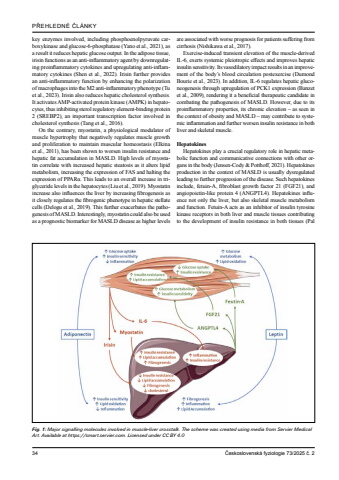
34 %u010ceskoslovensk%u00e1 fyziologie 73/2025 %u010d. 2P%u0158EHLEDN%u00c9 %u010cL%u00c1NKYkey enzymes involved, including phosphoenolpyruvate carboxykinase and glucose-6-phosphatase (Yano et al., 2021), as a result it reduces hepatic glucose output. In the adipose tissue, irisin functions as an anti-inflammatory agent by downregulating proinflammatory cytokines and upregulating anti-inflammatory cytokines (Shen et al., 2022). Irisin further provides an anti-inflammatory function by enhancing the polarization of macrophages into the M2 anti-inflammatory phenotype (Tu et al., 2023). Irisin also reduces hepatic cholesterol synthesis. It activates AMP-activated protein kinase (AMPK) in hepatocytes, thus inhibiting sterol regulatory element-binding protein 2 (SREBP2), an important transcription factor involved in cholesterol synthesis (Tang et al., 2016). On the contrary, myostatin, a physiological modulator of muscle hypertrophy that negatively regulates muscle growth and proliferation to maintain muscular homeostasis (Elkina et al., 2011), has been shown to worsen insulin resistance and hepatic fat accumulation in MASLD. High levels of myostatin correlate with increased hepatic steatosis as it alters lipid metabolism, increasing the expression of FAS and halting the expression of PPAR%u03b1. This leads to an overall increase in triglyceride levels in the hepatocytes (Liu et al., 2019). Myostatin increase also influences the liver by increasing fibrogenesis as it closely regulates the fibrogenic phenotype in hepatic stellate cells (Delogu et al., 2019). This further exacerbates the pathogenesis of MASLD. Interestingly, myostatin could also be used as a prognostic biomarker for MASLD disease as higher levels are associated with worse prognosis for patients suffering from cirrhosis (Nishikawa et al., 2017). Exercise-induced transient elevation of the muscle-derived IL-6, exerts systemic pleiotropic effects and improves hepatic insulin sensitivity. Its vasodilatory impact results in an improvement of the body%u2019s blood circulation postexercise (Dumond Bourie et al., 2023). In addition, IL-6 regulates hepatic gluconeogenesis through upregulation of PCK1 expression (Banzet et al., 2009), rendering it a beneficial therapeutic candidate in combating the pathogenesis of MASLD. However, due to its proinflammatory properties, its chronic elevation %u2013 as seen in the context of obesity and MASLD %u2013 may contribute to systemic inflammation and further worsen insulin resistance in both liver and skeletal muscle. HepatokinesHepatokines play a crucial regulatory role in hepatic metabolic function and communicative connections with other organs in the body (Jensen-Cody & Potthoff, 2021). Hepatokines production in the context of MASLD is usually dysregulated leading to further progression of the disease. Such hepatokines include, fetuin-A, fibroblast growth factor 21 (FGF21), and angiopoietin-like protein 4 (ANGPTL4). Hepatokines influence not only the liver, but also skeletal muscle metabolism and function. Fetuin-A acts as an inhibitor of insulin tyrosine kinase receptors in both liver and muscle tissues contributing to the development of insulin resistance in both tissues (Pal Fig. 1: Major signalling molecules involved in muscle-liver crosstalk. The scheme was created using media from Servier Medical Art. Available at https://smart.servier.com. Licensed under CC BY 4.0


