Page 11 - 2020 February E-issue
P. 11
Get to the Point!
More Writing Questions or Misconceptions
Previously in this article, I listed the top 10 questions or you present the proposal to? (For those of you howling about ending
misconceptions people have had about writing. Over the last 26 with a preposition, relax. That too, is evolving and most grammarians
years I've noticed that I tend to hear the same questions, comments, now agree it is OK to do so).
or arguments in almost every class I teach. Here's some more for
you to consider. Is that or which better to use? It's not a choice of "better," but
rather a choice of what you are trying to communicate. If you are
After a period, do you use one or two spaces? Years ago, adding some information to clarify a point, but is not essential, use
we were taught that you insert 2 spaces after the final punctuation which and set it apart with commas. If the information is required to
mark of a sentence. This was true when we used a typewriter, understand the point, use that without any commas.
but things have changed
with computers and word- CORRECT: The field staff require multimeters that are waterproof for
processing. As I write this, the project.
I am reminded that some
readers may never have INCORRECT: The field staff require multimeters, which are
used a typewriter so I waterpfoof, for the project.
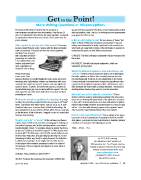
decided to add an image.
What's the difference between a dash, parentheses, and
All you need today commas? All three of these marks are used to set-off information
is one space. Your that adds, explains, or offers a side comment, however, they are
grammar checker is probably flagging the extra space and you've not interchangeable. Each has its own relationship to the content.
wondered why. Sophisticated software can determine (with some Commas indicate a moderate level of emphasis, parentheses offer
acuracy) if the mark is an end of a sentence and auto adjusts the a greater level of emphasis and may include a full sentence, and a
space to about 1.5 spaces. If you have two spaces, it creates an dash interrupts the contect with an abrupt departure. I recommend
uncomfortable large gap. Are you wrong with two spaces? No...but avoiding dashes because they seem to lose the connection.
don't argue this one at the lunch table; there's too much out there
promoting one space. When do I use an S' to indicate a possessive? This is
another common cause for grammatical confusion and only occurs
What words should be capitalized in a heading? In a major when you are working with plural words. If the plural does not end is
heading, the generally accepted format is to use caps on all "major" S, then add 's to show possession as is done with women's rights or
words. That means that "minor" words, such as "of, at, on, if, and" media's responsibility. However, if the plural ends in S, then you only
should be lower case. In second level, or third level headings, the add an ' as is done with attorneys' papers or the engineers' report.
general guideline is to use sentence format, which means a cap only This means the report belonged tomore than one engineer.
on the first word. If this is the case, I suggest a color or a period after
the lower level heading. How do I refer to plural numbers? This is related to the above
issue but is a bit of a contradiction. According to the MLA and APA
Should I use "who" or "whom"? If this confuses you there is style guides, you should not use an apostrophe to indicate a plural of
a good reason. Like it or not, over time, our language is evolving. In a number or an acronym. The following are correct:
our spoken language, who is often replacing whom, even when it
is grammatically correct. For example, when you answer the phone, 1990s JPEGs PCs
do you say "To whom do you wish to speak?" or "Who do you want
to speak with?" The first way is correct, but it sounds stuffy because
we don't hear it that often. (I'm just telling you the way it is; I'm not
advocating for either way here!) In writing however, the distinction © 2019, RGI Learning
is still observed and there is one simple rule: Use who to refer Lisa Moretto is the President of
to the subject of the sentence and whom to refer to an object of RGI Learning, Inc. For 24 years she has
the sentence. (I'll cover subjects and objects in a future article, if helped engineers improve their oral and
necessary.) written communication skills. Visit
www.rgilearning.com or
SUBJECT: Who provided you with the RFP?
call (866) 744-3032 to learn
OBJECT: To whom did you present the proposal? or Whom did about RGI’s courses.
get to the point FEBRUARY 2020 The ROCHESTER ENGINEER | 11