


Page 1186 - Workshop Manual - Aumark (BJ1051)
P. 1186
53-10
                                                    Battery-Battery


          Basic inspection

          1.     Appearance inspection
          (a).    First check if the appearance of the battery is good; if the connection of fixed tie-rod and
                 lead wire is firm.
          (b).    Observe the level of electrolyte: it is specified that the level should be 10-15 mm above the
                 pole plate; fill in distilled water if it is lower than the specified level.
          (c).    Observe if there are cracks on the battery case and central separator; knock the battery case
                 and central separator by crabstick, and listen to if there is broken sound, especially the
                 border of central separator and housing wall.
          (d).    If sight glasses is available, green means the electricity is sufficient; red and white means
                 electricity is insufficient and no power. It  will need carrying out the following capacity,
                 specific gravity and voltage inspection.
          2.     Capacity inspection
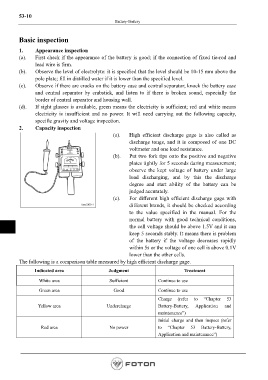
                                                   (a).    High efficient discharge gage is also called as
                                                          discharge tongs, and it is composed of one DC
                                                          voltmeter and one load resistance.
                                                   (b).    Put two fork tips onto the positive and negative
                                                          plates tightly for 5 seconds during measurement;
                                                          observe the kept voltage of battery under large
                                                          load discharging, and by this the discharge
                                                          degree and start ability  of the battery can be
                                                          judged accurately.
                                                   (c).    For different high efficient discharge gage with
                                                          different brands, it should be checked according
                                                          to the value specified in the manual. For the
                                                          normal battery with good technical conditions,
                                                          the cell voltage should be above 1.5V and it can
                                                          keep 5 seconds stably. It means there is problem
                                                          of the battery if the voltage decreases rapidly
                                                          within 5s or the voltage of one cell is above 0.1V
                                                          lower than the other cells.
          The following is a comparison table measured by high efficient discharge gage.
                Indicated area                   Judgment                          Treatment

                  White area                      Sufficient           Continue to use

                  Green area                       Good                Continue to use
                                                                       Charge   (refer  to  “Chapter  53
                  Yellow area                   Undercharge            Battery-Battery,  Application  and
                                                                       maintenance”)
                                                                       Initial charge and  then inspect (refer
                   Red area                       No power             to “Chapter 53 Battery-Battery,
                                                                       Application and maintenance”)


                                                                                                        Page 1186

