


Page 1182 - Workshop Manual - Aumark (BJ1051)
P. 1182
53-6
                                                    Battery-Battery


          Application and maintenance

          1.     Charging device
          Notes:
          It is a must to use DC to charge the battery; the AC supplied by power plant should be transformed
          to DC.
          (a).   Rectifier
                 Solid rectifier (copper oxide rectifier, selenium rectifier and silicon rectifier)in common,
                 charging pipe rectifier (tungsten lamp rectifier and mercury rectifier are the commonly used
                 rectifier. The input AC voltage normally is 110V or 220V, and then output nominal voltage
                 is 6V, 12V and 24V. Solid rectifier is used normally because it is easy to be used and needs
                 not care during charging.
          (b).    Controllable silicon voltage-regulated battery charger
                   During charging, it will need change the voltage to control the charging current because
                 the quantity of series connected batteries are different; the DC with adjustable voltage is
                 necessary. Silicon rectifier is light, small and easy to be moved, but there is still requirement
                 to heavier voltage-regulated transformer. The controllable silicon voltage-regulated battery
                 charger can overcome the above  defect. There is a kind of 8KW controllable silicon
                 voltage-regulated battery charger in the  market, which converts 220V AC through
                 controllable silicon rectifier. And the output DC is 0-220V and the output current is 0-4A.
          2.     Notices during charging
          (a).    Charge the battery in a dry and ventilated room, and the temperature should be between
                 5-40℃.
          (b).    Do not pile the batteries and do not put it on the ground directly; put it on the wooden rack.
                 Do not put it together with alkaline battery or other chemical stuff.
          (c).    No fire in the charging place and the battery should be far away from heat resource.
          (d).    Temperature of electrolyte can not exceed 45  ℃, otherwise take suitable measures to
                 decrease the temperature (make the charging current smaller, stop charging or put the battery
                 into water for cooling).
          3.     Charge criterion
          Notes:
          Make electrolyte by chemical pure sulfuric acid and distilled water, and it is not allowed to use
          industrial sulfuric acid and common water, because the impurity may cause battery discharge
          automatically or the pole plate may be damaged.

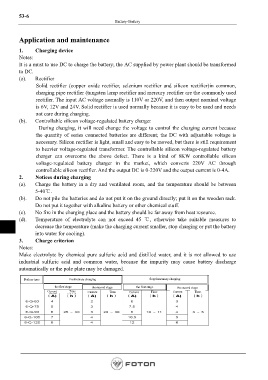
            Battery type        Preliminary charging               Supplementary charging
                         the first stage   the second stage   the first stage   the second stage
                      Current   Time    Current   Time    Current   Time      Current  Time


                                                                                                        Page 1182

