


Page 16 - AHATA
P. 16
Tuesday 2 december 2025 locAl
                                      A10

            Aruba: The island of Aloes


            ORANJESTAD – Aloe Vera, a                                                                                           However,  by  the  time  the
            succulent  plant  species,  is                                                                                      oil  industry  arrived  on  Aru-
            renowned for its incredible                                                                                         ba,  it  changed  the  labor
            properties  for  the  skin.  It  is                                                                                 market  on  Aruba,  shifting
            widely distributed and usu-                                                                                         away  from  agriculture.  It
            ally grows in tropical, semi-                                                                                       would  be  after  World  War
            tropical  and  arid  climates                                                                                       II  that  aloe  would  make  a
            on the planet. But this plant                                                                                       comeback.  And  eventu-
            also had a very prominent                                                                                           ally,  as  science  learned
            role in the history of Aruba,                                                                                       about the amazing proper-
            and  its  significance  to  the                                                                                     ties  of  aloe  gel,  the  indus-
            island’s  economy  endures                                                                                          try  shifted  from  producing
            to this day.                                                                                                        laxative  to  producing  skin
                                                                                                                                care.  An  interesting  fact  is
            The  leaves  of  Aloe  Vera                                                                                         that in 1951, the production
            contain a good amount of                                                                                            of Aruban aloe amounted
            gel which when used topi-                                                                                           to around 30 percent of the
            cally,  is  great  for  the  skin.                                                                                  total global production!
            Traditionally,  Arubans  use                                                                                        The impact and relevance
            this gel to treat minor burns                                                                                       of aloe is visible all around
            and  other  skin  ailments,                                                                                         Aruba.  While  most  homes
            or  just  to  keep  skin  supple                                                                                    will  have  a  few  plants  for
            and  looking  bright  and                                                                                           personal  use  and  decora-
            nourished.  Aside  from  the                                                                                        tion, houses are also deco-
            gel, aloe contains a bitter,                                                                                        rated with aloe motifs, and
            yellow  substance  (called                                                                                          at  some  point,  aloe  even
            aloin) which is a gentle but                                                                                        featured  on  post  stamps.
            powerful  laxative,  and  it  is   introduced  in  other  islands  Under  Commander  Jan  and Europe. The aloin from   Around  1920,  about  two-
            also the origin of the indus-  of  the  Caribbean  to  culti-  Helenus  Ferguson  (1866-  Aruba  and  Curaçao  was   thirds  of  Aruba  was  aloe
            try of aloe in Aruba.        vate and harvest the aloe  1871), aloe experienced a  known  to  be  one  of  the      fields, earning our island the

                                         to produce the laxative.     boom,  which  is  why  there  best  in  the  world  and  was   nickname “The Island of Al-
            Aloe  vera  was  introduced                               is a road named after him,  more     expensive,   which   oes.” And in 1955, the aloe
            in  Aruba  around  1840,     Around  1920,  about  two-   which  goes  through  the  meant  that  at  the  time,  it   became a part of Aruba’s
            when  most  of  the  island’s   thirds  of  Aruba  was  aloe  aloe fields. In the 19th cen-  had  significant  economic   coat  of  arms,  symbolizing
            inhabitants were farmers of   fields,  earning  our  island  tury,  Aruba  was  the  main  impact, particularly for the   prosperity for the island.q
            little  means.  Dutch  Gover-  the  nickname  “The  Island  supplier  of  aloin  for  laxa-  local farmers.
            nor Van Raders introduced    of Aloes.”                   tive,  which  was  imported                                Images from the archive of
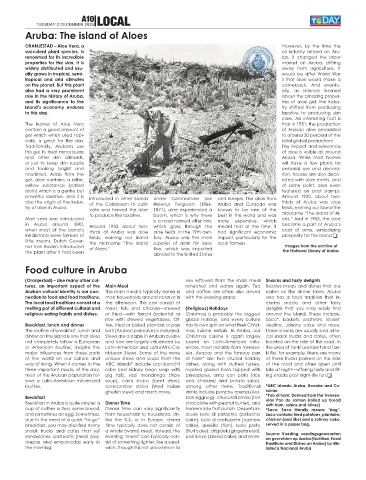
            the plant after it had been                               abroad to the United States                               the National Library of Aruba.


            Food culture in Aruba


            (Oranjestad) – Like many other cul-                                     see  leftovers  from  the  main  meal  Snacks and tasty delights
            tures,  an  important  aspect  of  the  Main Meal                       reheated  and  eaten  again.  Tea  Besides meals and dishes that are
            Aruban cultural identity is our con-  The main meal is typically eaten in  and  coffee  are  often  also  served  eaten on the dinner table, Aruba
            nection to food and food traditions.  most households around noon or in  with the evening snack.            also  has  a  food  tradition  that  in-
            The local food traditions consist of a  the  afternoon.  This  can  consist  of                             cludes  snacks  and  other  tasty
            melting pot of different cultural and  meat,  fish,  and  chicken—stewed  (Religious) Holidays              delights  that  you  may  easily  find
            religious eating habits and dishes.  or  fried—with  funchi  (polenta)  or  Christmas  is  probably  the  biggest  around  the  island.  These  include,
                                                rice  with  stewed  vegetables.  Of-  global  holiday,  and  every  culture  Saco*,  baskets,  pastechi,  kroket,
            Breakfast, lunch and dinner         ten, fried or boiled plantain or pan  has its own spin on what their Christ-  deditos,  Johnny  cake  and  more.
            The routine of breakfast, lunch and  bati (Aruban pancake) is included.  mas  cuisine  entails.  In  Aruba,  our  These snacks are usually sold at lo-
            dinner on the island is one that does  Stews are a staple in Aruban cuisine  Christmas  cuisine  is  again  largely  cal  snack  trucks  and  cafes,  often
            not completely follow a European  and can are largely influenced by  based  on  Latin-American  influ-      located on the side of the road. In
            or  American  routine,  despite  the  Latin-American and Latin/Afro-Ca-  ences, most notably form Venezu-   the area of Tanki Leendert and Tan-
            major  influences  from  these  parts  ribbean  Stews.  Some  of  the  more  ela.  Ayacas  and  the  famous  pan  ki flip, for example, there are many
            of  the  world  on  our  culture  and  unique  stews  and  soups  from  the  di  ham*  are  two  crucial  holiday  of these trucks parked on the side
            way of living. When it comes to the  ABC  Islands*  include  sopi  bonch’i  dishes,  along  with  stuffed  turkey,  of  the  road  and  often  open  until
            three important meals of the day,  rabo  (red  kidney  bean  soup  with  roasted  glazed  ham  topped  with  late at night—offering tasty and fill-
            most of the Aruban population fol-  pig  tail),  sopi  mondongo  (tripe  pineapples,  arroz  con  pollo  (rice  ing snacks post night-life fun.q
            lows  a  Latin-American  influenced  soup),  carni  stoba  (beef  stew),  and  chicken)  and  potato  salad,
            routine.                            comcomber  stoba  (West  Indian  among  other  items.  Traditional      *ABC Islands: Aruba, Bonaire and Cu-
                                                gherkin stew) and much more.        drinks include ponche crema (Aru-   racao
            Breakfast                                                               ban eggnog), chuculati pinda (hot   *Pan di ham: Derived from the Venezu-
                                                                                                                        elan  Pan  de  Jamon  (rolled  up  bread
            Breakfast in Aruba is quite simple: a  Dinner Time                      chocolate with peanut butter), and   with ham, raisins and olives)
            cup of coffee or tea, some bread,  Dinner  time  can  vary  significantly  homemade fruit punch. Desserts in-  *Saco:  Saco  literally  means  “bag”.
            and sometimes an egg. Sometimes,  from household to household. Un-      clude  bolo  di  pistachio  (pistachio   Saco contains fried potatoes, plantains,
            due to the need of a quick “to-go”  like  the  U.S.  or  in  Europe,  dinner  cake), bolo di cashupete (cashew   chicken (and ribs) and a Johnny cake,
            breakfast, you may also find many  time  typically  does  not  consist  of  cake),  quesillo  (flan),  bolo  preto   served in a paper bag.
            snack  trucks  and  cafes  that  sell  a whole (warm) meal. Instead, the  (fruit cake), drigidek (gingerbread),   Source: Voeding, voedingsgewoonten
            sandwiches, pastechis (meat pie),  evening “meal” can typically con-    pan boyo (bread cake) and more.     en gerechten op Aruba (Nutrition, Food
            arepas  and  empanadas  early  in  sist of something lighter, like a sand-                                  Traditions and Dishes on Aruba) by Bib-
            the morning.                        wich, though it is not uncommon to                                      lioteca Nacional Aruba

