


Page 116 - Studentr's Book_THINK 1_A2
P. 116
THJNK

                             Hard journeys for
                             schoolchildren


        Culture


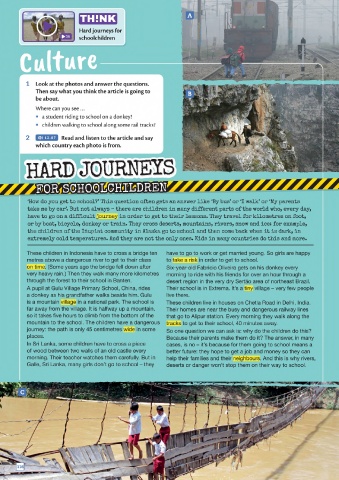
              Look at the photos and answer the questions.
              Then say what you think the article is going to
              be about.
              Where can you see ...
              •  a student riding to school on a donkey?
              •  children walking to school along some rail tracks?

              <n>)  1 2 .0 7  Read and listen to the article and say
              which country each photo is from.


          har dt jour neis


              EOR(S.GHO0KCH'IIsDREN'                        f / / / / / / / / / / / / / / / ^


           ‘How do you get to school?’ This question often gets an answer like ‘By bus’ or ‘I walk’ or ‘My parents
           take me by car’. But not always - there are children in many different parts of the world who, every day,
           have to go on a difficult journey in order to get to th eir lessons. They travel for kilometres on foot,
           or by boat, bicycle, donkey or train . They cross deserts, mountains, rivers, snow and ice: for example,
           the children of the Ihupiat community in Alaska go to school and then come back when i t  is dark, in
           extremely cold temperatures. And they are not the only ones. Kids in many countries do this and more.

          These children in Indonesia have to cross a bridge ten  have to go to work or get married young. So girls are happy
           metres above a dangerous river to get to their class  to take a risk in order to get to school.
          on time. (Some years ago the bridge fell down after  Six-year-old Fabricio Oliveira gets on his donkey every
          very heavy rain.) Then they walk many more kilometres  morning to ride with his friends for over an hour through a
          through the forest to their school in Banten.    desert region in the very dry Sertao area of northeast Brazil.
          A pupil at Gulu Village Primary School, China, rides  Their school is in Extrema. It’s a tiny village -  very few people
          a donkey as his grandfather walks beside him. Gulu  live there.
           is a mountain village in a national park. The school is  These children live in houses on Chetla Road in Delhi,  India.
          far away from the village.  It is halfway up a mountain,  Their homes are near the busy and dangerous railway lines
          so it takes five hours to climb from the bottom of the  that go to Alipur station. Every morning they walk along the
           mountain to the school. The children have a dangerous  tracks to get to their school, 40 minutes away.
          journey: the path is only 45 centimetres wide in some  So one question we can ask is: why do the children do this?
           places.                                          Because their parents make them do it? The answer, in many
           In Sri Lanka, some children have to cross a piece  cases, is no -  it’s because for them going to school means a
          of wood between two walls of an old castle every  better future: they hope to get a job and money so they can
           morning. Their teacher watches them carefully. But in  help their families and their neighbours. And this is why rivers,
          Galle, Sri Lanka, many girls don’t go to school -  they  deserts or danger won’t stop them on their way to school.

