


Page 100 - Think 4. Teacher's Book B2
P. 100
Unit 9
          Take charge                        Reading; Train to


           6   Check/clarify: hasty.
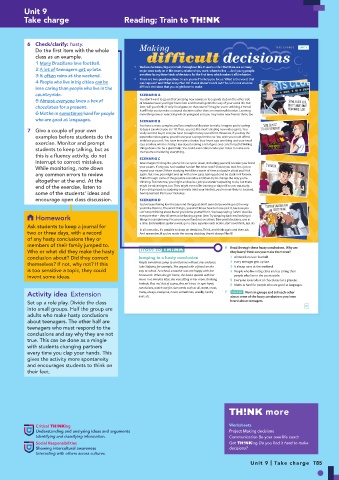
             Do the first item with the whole     Making                                          TAKE CHARGE  UNIT 9
             class as an example.
             1 Many Brazilians love football.
             2 A lot of teenagers get up late.  1  We face decisions, big and small, throughout life. It seems unfair that there are so many
                                                  major ones early on in life: exams, relationships, work, where to live … And young people
             3 It often rains at the weekend.     are often facing these kinds of decisions for the first time, which makes it all the harder.
             4 People who live in big cities can be   2  There are two good questions to ask yourself to help you focus: ‘What is the worst that
                                                  can happen?’ and ‘What is my Plan B if Plan A doesn’t work out?’ So, let’s look at some
             less caring than people who live in the   difficult decisions that you might have to make.
             countryside.                         SCENARIO A
             5 Almost everyone loves a box of   3  You don’t want to go on that amazing new course or to a sports club on the other side
                                                  of town because you’ll get home late and that will get in the way of your social life. But
             chocolates for a present.            later, will you think, ‘If only I had gone on that course?’ Imagine you’re advising a friend.
             6 Maths is sometimes hard for people   It will help you to make a rational decision rather than an emotional decision. Learning
                                                  something new or exercising will do you good and you may make new friends there, too.
             who are good at languages.           SCENARIO B
                                                4  You have a more complex and less emotional decision to make. Imagine you’re saving
           7  Give a couple of your own           to buy a car when you are 18. Then, you see the most amazing new video game. You
                                                  really want to buy it and you have enough money saved for it. However, if you buy the
             examples before students do the      expensive video game, you will use your savings for the car. You wish you could afford
             exercise. Monitor and prompt         both but you can’t. You have to make a choice. Your heart says one thing and your head
                                                  says another, which is tricky. How about making a list of pros and cons for both? Writing
             students to keep talking, but as     things down can be a great help. You could even colour code your notes to make sure
                                                  that you’re considering everything.
             this is a fluency activity, do not   SCENARIO C
             interrupt to correct mistakes.     5  Now imagine feeling like you’ve let everyone down, including yourself, because you failed
             While monitoring, note down          your exams. If only you had studied harder! But what now? Should you look for a job or
                                                  repeat your exams? More studying feels like a waste of time and you’re afraid you’ll fail
             any common errors to review          again. But now, you might end up with a low-paid, boring job and be stuck in it forever.
             altogether at the end. At the        Think through some of the possible scenarios and then try to change the way you’re
                                                  thinking. For instance, you might end up in a job you weren’t expecting to do, but there
             end of the exercise, listen to       might be advantages, too. They might even offer training or days off so you can study.
                                                  If you did go back to studying and really tried your hardest, you’re more likely to succeed,
             some of the students’ ideas and      having learned from your mistakes.
             encourage open class discussion.     SCENARIO D
                                                6  You’ve been feeling low this year and things just don’t seem to be working out the way
                                                  you’d like them to. The worst thing is, you don’t know how to move past it, because you
                                                  can’t stop thinking about it and you blame yourself for it. You keep saying, I wish I was like
              Homework                            everyone else – they all seem to be having a great time. Try stepping back and looking at
                                                  things in a simpler way. Focus on yourself and not on others. Take small decisions, one at
                                                  a time. Eat breakfast, go for a walk, go to class, separate each action, don’t overthink, just do.
           Ask students to keep a journal for
           two or three days, with a record     7  In all scenarios, it’s sensible to sleep on decisions. Think, and think again and then act.
                                                  And remember, if you’ve made the wrong decision, there’s always Plan B!
           of any hasty conclusions they or
           members of their family jumped to.                                   6  Read through these hasty conclusions. Why are
           Who or what did they make the hasty                                    they hasty? How can you make them true?
           conclusion about? Did they correct     Jumping to a hasty conclusion   1  All Brazilians love football.
           themselves? If not, why not? If this   People sometimes jump to conclusions without any evidence.   2  Every teenager gets up late.
                                                  Take Stefania, for example. She argued with a friend on the
                                                                                  3  It always rains at the weekend.
           is too sensitive a topic, they could   way to school. At school, a teacher was not happy with her   4  People who live in big cities are less caring than
           invent some ideas.                     homework. When she got home, she had a quarrel with her   people who live in the countryside.
                                                  mum. Five minutes later, she was sitting in her room, thinking,   5  Everyone loves a box of chocolates for a present.
                                                  ‘nobody likes me’. But of course, this isn’t true. To spot hasty   6  Maths is hard for people who are good at languages.
                                                  conclusions, watch out for clue words such as all, none, most,
                                                                                  SPEAKING   Work in groups and tell each other
           Activity idea  Extension               many, always, everyone, never, sometimes, usually, hardly   7   about some of the hasty conclusions you have
                                                                                  SPEAKING
                                                  ever, etc.
           Set up a role play. Divide the class                                   heard about teenagers.
           into small groups. Half the group are                                                            85
           adults who make hasty conclusions
           about teenagers. The other half are
           teenagers who must respond to the
           conclusions and say why they are not
           true. This can be done as a mingle
           with students changing partners
           every time you clap your hands. This
           gives the activity more spontaneity
           and encourages students to think on
           their feet.


                                                                                              more


              Critical   ing                                                      Worksheets
              Understanding and analysing ideas and arguments                     Project Making decisions
              Identifying and classifying information.                            Communication Be your own life coach
              Social Responsibilities                                             Get     ing Do you find it hard to make
              Showing intercultural awareness                                     decisions?
              Interacting with others across cultures.
                                                                                         Unit 9 | Take charge T85

