


Page 59 - Think 4. Teacher's Book B2
P. 59
Unit 4                           Developing Speaking; Phrases for fluency;
           The art of thinking              Functions


          Warmer
          Revise common adverbial phrases
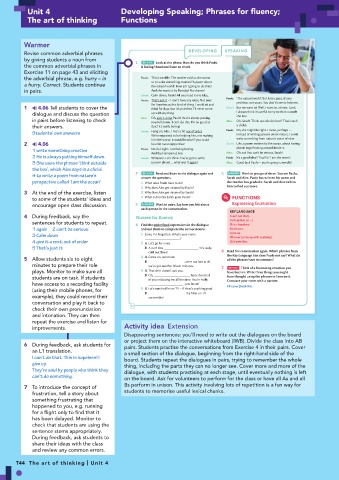
          by giving students a noun from             4.06   Look at the photo. How do you think Paulo
          the common adverbial phrases in        1   is feeling? Read and listen to check.
          Exercise 11 on page 43 and eliciting
          the adverbial phrase, e.g. hurry – in    Paulo:  This is terrible. The teacher told us she wants
          a hurry. Correct. Students continue         us to write something creative! ‘A poem about
                                                      the natural world.’ How am I going to do that?
          in pairs.                                   And she wants it by Tuesday! No chance!
                                                   Sarah:  Calm down, Paulo! All you need is one idea.
                                                   Paulo:  That’s just it – I don’t have any ideas. Not one!   Paulo:  ‘The natural world’. But listen, guys, it’s my
                                                      I’m hopeless at this kind of thing. I could sit and   problem, not yours. You don’t have to help me.
          1     4.06 Tell students to cover the       think for days, but it’s pointless. I’ll never come   Sarah:  But we want to! Well, I want to, at least. Look,
            dialogue and discuss the question         up with anything.             I always think it’s useful to try to think outside
                                                                                    the box.
            in pairs before listening to check     Alex:   Oh, give it a rest Paulo! You’re always putting   Alex:   Oh, Sarah! ‘Think outside the box?’ That’s such
                                                      yourself down. ‘I can’t do this, I’m no good at
            their answers.                            that!’ It’s really boring!    a cliché.
            Students’ own answers                  Sarah:  Hang on, Alex. That’s a bit out of order.   Paulo:  No, she might be right. I mean, perhaps …
                                                                                    instead of writing a poem about nature, I could
                                                      We’re supposed to be helping him, not making
                                                      him feel worse. It would be nice if you could   write something from nature’s point of view.
          2    4.06                                   be a bit more supportive!  Sarah:  Like, a poem written by the ocean, about having
            1 write something creative             Paulo:  No, he’s right. I am being boring.   Alex:   plastic bags floating around inside it.
                                                                                    Oh, no! You can’t be serious, Sarah!
                                                      And bad-tempered, too.
            2 He is always putting himself down.     Sarah:  Whatever. Let’s think. You’ve got to write   Paulo:  It’s a good idea! I’ll call it: ‘I am the ocean’.
            3 She uses the phrase ‘think outside      a poem about … what was it again?  Alex:   Good luck Paulo – you’re going to need it!
            the box’, which Alex says is a cliché.
                                                                                 SPEAKING   Work in groups of three. You are Paulo,
                                                     4.06   Read and listen to the dialogue again and
                                                                                 SPEAKING
            4 to write a poem from nature’s      2   answer the questions.     5   Sarah and Alex. Paulo has written his poem and
            perspective called ‘I am the ocean’    1  What does Paulo have to do?  the teacher has graded it. Sarah and Alex talk to
                                                   2  Why does Alex get irritated by Paulo?  him to find out more.
          3  At the end of the exercise, listen    3  Why does Alex get irritated by Sarah?
            to some of the students’ ideas and     4  What is the idea Sarah gives Paulo?  FUNCTIONS
            encourage open class discussion.     3   SPEAKING   Work in pairs. Say how you felt about   Expressing frustration
                                                   SPEAKING
                                                   each person in the conversation.
                                                                                  KEY LANGUAGE
          4  During feedback, say the            Phrases for fluency              I can’t (do that).
            sentences for students to repeat.    4  Find the underlined expressions in the dialogue   I’m hopeless (at …)

                                                                                  This is hopeless!
            1 again   2 can’t be serious           and use them to complete the conversations.  No chance.
            3 Calm down                            1  Sorry, I’ve forgotten. What’s your name   I give up.
                                                                                  I’ll never (come up with anything).

            4 give it a rest; out of order         2  A  Let’s go for a run.   ?  (It’s) pointless.
            5 That’s just it                         B  A run? You       ! It’s really
                                                     cold out there!           6  Read the conversation again. Which phrases from
          5  Allow students six to eight           3  A  Come on, we’re late!   , we’re not late at all,   the Key Language box does Paulo not say? What do
                                                                                 all the phrases have in common?
                                                     B

            minutes to prepare their role            we’ve got another fifteen minutes.  7   WRITING   Think of a frustrating situation you
            plays. Monitor to make sure all        4  A  That shirt doesn’t suit you.  have been in. Write three things you might
            students are on task. If students        B  Oh,         , Boris. I’m tired   have thought using the phrases in Exercise 6.
                                                     of you criticising me all the time. You’re really
                                                                                 Compare your notes with a partner.
            have access to a recording facility                   , you know?    I’ll never finish this.
            (using their mobile phones, for        5  A  Let’s watch a film on TV – if there’s anything good.

                                                     B
                                                                  . The films on TV
            example), they could record their        are terrible!
            conversation and play it back to
            check their own pronunciation      44
            and intonation. They can then
            repeat the exercise and listen for
            improvements.                    Activity idea  Extension
                                             Disappearing sentences: you’ll need to write out the dialogues on the board
                                             or project them on the interactive whiteboard (IWB). Divide the class into AB
          6  During feedback, ask students for   pairs. Students practise the conversations from Exercise 4 in their pairs. Cover
            an L1 translation.               a small section of the dialogue, beginning from the right-hand side of the
            I can’t do that. This is hopeless! I    board. Students repeat the dialogues in pairs, trying to remember the whole
            give up.                         thing, including the parts they can no longer see. Cover more and more of the
            They’re said by people who think they   dialogue, with students practising at each stage, until eventually nothing is left
            can’t do something.              on the board. Ask for volunteers to perform for the class or have all As and all
          7  To introduce the concept of     Bs perform in unison. This activity involving lots of repetition is a fun way for
            frustration, tell a story about   students to memorise useful lexical chunks.
            something frustrating that
            happened to you, e.g. running
            for a flight only to find that it
            has been delayed. Monitor to
            check that students are using the
            sentence stems appropriately.
            During feedback, ask students to
            share their ideas with the class
            and review any common errors.
       T44  The art of thinking | Unit 4

