


Page 64 - Think 4. Teacher's Book B2
P. 64
Unit 5
Too much tech? Reading; Train to
6 Refer students back to Exercise
DIGITAL
DIGITAL
DIGITAL
2 on page 48 and emphasise the TOO MUCH TECH? UNIT 5
DIGITAL
DIGITAL
DIGITAL
DIGITAL
DIGITAL
need to weigh up advantages A 1 1
and disadvantages before making DIGITAL Write down all the things that you like doing but never find the
t you like doing but never find the
Write do
wn all the things tha
time to do.
By cutting do
wn your online activity you will start to
decisions. Divide the class into detox time to do. By cutting down your online activity you will start to
free up some time to do these things.
pairs and ask students to add 2
as many ideas to each column Don’t expect to be able to just put down your phone and never
touch it again. Instead give yourself a time limit of how long
as they can. To focus on the n average, we look at our phones 200 times a day. you can use it each day. Even better, say exactly when you will
That’s more than 12 times for every hour we’re awake!
importance of asking questions OA quarter of all people spend more time on their allow yourself to use it and stick to that plan.
3
before making decisions and phone than they do asleep in bed. Nearly three-quarters Decide on one change you want to make. Always leave your
of teenagers prefer texting to actually speaking with other
considering the consequences people and, presumably, most of those teens also think that charger at home, so that you have to use your phone less
having a good wireless router in the house is more important
to save the battery, and work towards achieving this. When
of different decisions, stress than having a fridge. On average, a teenager will send 3,400 you’re comfortable with that change, move onto another.
the particular relevance of the messages from their bed each month! 4
These are just a few of the frightening statistics that show how
third column. Listen to some addicted we have become to technology. And the effects of this When you’re with others, you should always give them your
attention. If you keep looking at your phone, then you are not.
of their ideas in open class and are just as scary. Research has shown that our intensive phone This is a sign that it’s time to start putting your phone away.
usage means we are finding it harder to get a good night’s sleep.
encourage further discussion. Our addiction to social media means we are becoming more self- 5
absorbed and screens are making our children less caring people, Find someone to start your detox with. That way, you can offer
as they are less likely to think about the impact each other support and help each other through those difficult
7 Divide the class into three groups of what they might post on social media. times. And if you need help, try and talk to them face to face
rather than via text or video calls.
and ask students to find a partner Clearly, we must do something about this. 6
But what?
within their group. Assign one More and more experts are It’s simple. If you haven’t got your phone with you, then you can’t
of the three situations to each recommending a digital detox – use it. Don’t be scared – you’ll soon find lots of other things to do.
You may even start to notice things you never noticed before.
an amount of time every day when
group. Students use the PMI we don’t allow ourselves to look 7
at our phones and other screens.
strategy to come to a decision on Most people would probably agree Tell friends and family members what you’re doing. Let them know
you won’t always be answering their messages the minute you
their situation in pairs. When the this is a good idea, but putting it into get them. Who knows – they might even be tempted to join you.
practice is not that easy. That’s why
majority of students have reached we’ve come up with a seven-step
a decision, regroup students into plan to help you put away your
phone and get back to the
the original three larger groups business of living your life.
for them to discuss their ideas
and agree on the best decision
for their situation.
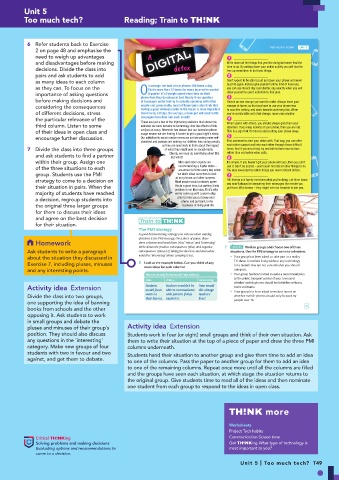
The PMI strategy
A good brainstorming strategy you can use when making
decisions is the PMI strategy. On a piece of paper, draw
Homework three columns and head them ‘plus’, ‘minus’ and ‘interesting’.
Write down the positive consequences (plus) and negative 7 SPEAKING
SPEAKING Work in groups and choose one of these
Ask students to write a paragraph consequences (minus) of taking the decision, and also what situations. Use the PMI strategy to come to a decision.
about the situation they discussed in would be ‘interesting’ about carrying it out. • Your group has been asked to take part in a reality
TV show. It involves living without any technology
Exercise 7, including pluses, minuses 6 Look at the example below. Can you think of any for a month. You are not sure whether you should
more ideas for each column?
and any interesting points. take part.
Phones should be banned from schools • Your group has been invited to make a recommendation
to the public transport service of your town as to
plus minus interesting
whether mobile phones should be forbidden on buses,
Activity idea Extension Students Students wouldn’t be How would • Your group has been asked to make a report on
trains and trams.
would focus able to communicate this change
Divide the class into two groups, more on with parents if they teachers’ whether mobile phones should only be used by
their lessons. needed to.
lives?
one supporting the idea of banning people over 18.
books from schools and the other 49
opposing it. Ask students to work
in small groups and debate the
pluses and minuses of their group’s Activity idea Extension
position. They should also discuss Students work in four (or eight) small groups and think of their own situation. Ask
any questions in the ‘interesting’ them to write their situation at the top of a piece of paper and draw the three PMI
category. Make new groups of four columns underneath.
students with two in favour and two Students hand their situation to another group and give them time to add an idea
against, and get them to debate. to one of the columns. Pass the paper to another group for them to add an idea
to one of the remaining columns. Repeat once more until all the columns are filled
and the groups have seen each situation, at which stage the situation returns to
the original group. Give students time to read all of the ideas and then nominate
one student from each group to respond to the ideas in open class.
more
Worksheets
Project Tech habits
Critical ing Communication Screen time
Solving problems and making decisions Get ing What type of technology is
Evaluating options and recommendations to most important to you?
come to a decision.
Unit 5 | Too much tech? T49

