


Page 65 - Think 4. Teacher's Book B2
P. 65
Unit 5
           Too much tech?                   Grammar; Functions; Vocabulary


          Warmer
          Write the letters l, m, s, n t and n a t
          on the board. Tell students that they     GRAMMAR                        FUNCTIONS
          are the initial letters of five modal     Obligation, permission and     Advice and obligation
                                                    prohibition (review)
                                                                                 WRITING   Imagine an exchange student is coming
          and semi-modal forms (let, must,       1  Complete the sentences from the text on page 49.   3   to your school for a few weeks. Write down three
          should, need to and not allowed to).     Then complete the rule with let, must, should, need   rules and three pieces of advice to help them.
          Elicit the forms and write them on       to and not be allowed to.     You have to arrive at school by 9 am.
          the board.                               1  Clearly, we       do something   4   SPEAKING   Work in pairs and compare your sentences.
                                                                                 SPEAKING
                                                    about this.
                                                   2  When you’re with others, you
                                                                 always give them   VOCABULARY
          1   1 must   2 should                     attention.                     Technology (nouns)
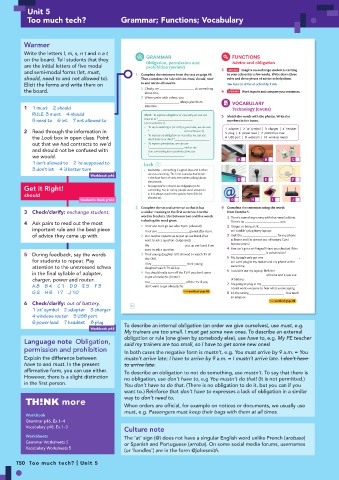
            RULE: 3 must   4 should                 RULE:  To express obligation or necessity, we can use   5  Match the words with the photos. Write the
            5 need to   6 let   7 not allowed to    have to or  3                numbers in the boxes.
                                                    (as in sentence 1).
                                                    •  To say something is (or isn’t) a good idea, we can use   1  adapter |  2 ‘at’ symbol |  3 charger |  4 headset
          2  Read through the information in         4             as in sentence 2).  5 plug |  6 power lead |  7  protective case
            the Look box in open class. Point       •  To express no obligation or necessity, we can use    .  8 USB port |   9 webcam |   10  wireless router

                                                     don’t have to or don’t  5
            out that we had contracts to we’d       •  To express permission, we can use

                                                                   and to say
            and should not be confused with          6 that something is not permitted we use
            we would.                                7             .
            1 isn’t allowed to   2 ’re supposed to    Look                           A        B         C
            3 don’t let   4 ’d better turn          •  had better = something is a good idea and is often

                                 Workbook p46        used as a warning. The form is always had better
                                                     + the base form of verb, even when talking about   D   E   F
                                                     the present.
          Get it Right!                             •  be supposed to = there’s an obligation to do
                                                     something, but in reality, people don’t always do
          should                                     it. It is always used in the passive form (like be
                                                     allowed to).
                             Student’s Book p124                                  G      H       I      J
                                                 2  Complete the second sentence so that it has   6  Complete the sentences using the words
          3  Check/clarify: exchange student.      a similar meaning to the first sentence. Use the   from Exercise 5.
                                                   word in brackets. Use between two and five words   1  There’s something wrong with that email address.
                                                   including the word given.      There’s no        in it.
          4  Ask pairs to read out the most        1  Their son can’t go out after 8 pm. (allowed)       ,
            important rule and the best piece        Their son       go out after 8 pm.  2  I forgot to bring a UK
                                                                                  so I couldn’t plug in my laptop.
            of advice they came up with.           2  Our teacher expects us to put up our hand if we   3  I left the       for my phone
                                                    want to ask a question. (supposed)  at home and I’m almost out of battery. Can I
                                                    We             put up our hand if we   borrow yours?
                                                    want to ask a question.      4  You can’t get a wi-fi signal? Have you checked if the

          5  During feedback, say the words        3  Their young daughter isn’t allowed to watch TV all   5  My laptop’s only got one    is switched on?   ,

                                                    day. (let)
            for students to repeat. Pay             They            their young   so I can’t plug in my mouse and my phone at the
            attention to the unstressed schwa       daughter watch TV all day.    same time.
            in the final syllable of adapter,      4  You should really turn off the TV if you don’t want   6  I couldn’t use my laptop. I left the

                                                                                               at home and it was out
                                                    to get a headache. (better)
            charger, power and router.              You            off the TV if you   of battery.
            A 8   B 4   C 1   D 9   E 5   F 3       don’t want to get a headache.  7  I’m going to plug in my       .
                                                                                  I don’t want everyone to hear what you’re saying.
              G 2   H 6   I 7   J 10                                workbook page 46  8  It’s the wrong       . You need
                                                                                  an adaptor.
                                                                                                  workbook page 48
          6  Check/clarify: out of battery.    50
            1 ‘at’ symbol   2 adapter   3 charger
            4 wireless router   5 USB port
            6 power lead   7 headset   8 plug  To describe an internal obligation (an order we give ourselves), use must, e.g.
                                 Workbook p48
                                             My trainers are too small. I must get some new ones. To describe an external
                                             obligation or rule (one given by somebody else), use have to, e.g. My PE teacher
          Language note  Obligation,         said my trainers are too small, so I have to get some new ones!
          permission and prohibition         In both cases the negative form is mustn’t, e.g. You must arrive by 9 a.m. = You
          Explain the difference between     mustn’t arrive late; I have to arrive by 9 a.m. = I mustn’t arrive late. I don’t have
          have to and must. In the present   to arrive late.
          affirmative form, you can use either.   To describe an obligation to not do something, use mustn’t. To say that there is
          However, there is a slight distinction   no obligation, use don’t have to, e.g You mustn’t do that! (It is not permitted.)
          in the first person.               You don’t have to do that. (There is no obligation to do it, but you can if you
                                             want to.) Reinforce that don’t have to expresses a lack of obligation in a similar
                       more                  way to don’t need to.
                                             When orders are official, for example on notices or documents, we usually use
                                             must, e.g. Passengers must keep their bags with them at all times.
          Workbook
          Grammar p46, Ex.1–4
          Vocabulary p48, Ex.1–3
                                             Culture note
          Worksheets                         The ‘at’ sign (@) does not have a singular English word unlike French (arobase)
          Grammar Worksheets 5               or Spanish and Portuguese (arroba). On some social media forums, usernames
          Vocabulary Worksheets 5
                                             (or ‘handles’) are in the form @johnsmith.
       T50  Too much tech? | Unit 5

