


Page 319 - maintg
P. 319
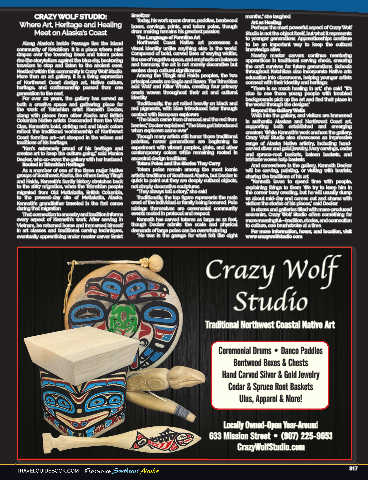
CRAZY WOLF STUDIO:             Smeltzer.                            months,” she laughed.
                                             Today, his work spans drums, paddles, bentwood
       Where Art, Heritage and Healing     boxes, carvings, prints, and totem poles, though   Art as Healing
                                                                                  Perhaps the most powerful aspect of Crazy Wolf
            Meet on Alaska’s Coast         drum making remains his greatest passion.  Studio is not the object itself, but what it represents
                                             The Language of Formline Art       to younger generations. Apprenticeships continue
        Along  Alaska’s  Inside  Passage  lies  the  island   Northwest  Coast  Native  art  possesses  a   to be an important  way to keep the cultural
      community of Ketchikan. It is a place where mist   visual identity unlike anything else in the  world.   knowledge alive.
      drapes over the towering trees and totem poles   Composed of bold, curved lines of varying widths,   Nearby  master  carvers  continue  mentoring
      rise like storytellers against the blue sky, beckoning   the use of negative space, and emphasis on balance   apprentices in traditional carving sheds, ensuring
      travelers to stop and listen to the ancient ones.   and harmony, the art is not merely decorative but   the craft survives for future generations. Schools
      Nestled within this community is Crazy Wolf Studio.   evokes deep cultural significance.  throughout Ketchikan also incorporate Native arts
      More than an art gallery, it is a living expression   Among the Tlingit and Haida peoples, the two   education into classrooms, helping younger artists
      of  Northwest  Coast  design  art,  Native  culture,   principal crests are Eagle and Raven. The Tsimshian   connect with their identity and heritage.
      heritage, and craftsmanship passed from one   add  Wolf and Killer  Whale, creating four primary   “There is so much healing in art,” she said. “It’s
      generation to the next.              crests  woven throughout their art and cultural   nice to see these  young people  with troubled
        For over 20  years, the gallery has served as   identity.               backgrounds pick up the art and find their place in
      both a creative space and gathering place for   Traditionally, the art relied heavily on black and   the world through the designs.”
      the  work of  Tsimshian artist Kenneth  Decker,   red pigments, with blue introduced later through   Beyond the Gallery Walls
      along  with pieces from other  Alaska and British   contact with European explorers.  Walk into the gallery, and visitors are immersed
      Columbia Native artists. Descended from the Wolf   “The black came from charcoal and the red from   in  authentic  Alaskan  and  Northwest  Coast  art,
      Clan, Kenneth’s bold, striking red and black colors   berries,” Decker explained. “The blue got introduced   supporting both established and emerging
      reflect  the  traditional  workmanship  of  Northwest   when explorers came over.”   creators. While Kenneth’s work anchors the gallery,
      Coast formline art—art steeped in the values and   Though many artists still honor those traditional   Crazy  Wolf Studio also showcases an impressive
      traditions of his heritage.          palettes, newer generations are beginning to   range  of  Alaska  Native  artistry,  including  hand-
        “Ken’s  extremely  proud  of  his  heritage  and   experiment with vibrant purples, pinks, and other   carved silver and gold jewelry, ivory carvings, cedar
      creates art to keep the culture going,” said Monica   contemporary colors  while remaining rooted in   and spruce-root baskets, baleen baskets, and
      Decker, who co-owns the gallery with her husband.   ancestral design traditions.   intricate woven kelp baskets.
        Rooted in Tsimshian Heritage         Totem Poles and the Stories They Carry  And somewhere in the gallery, Kenneth Decker
        As a member of one of the three major Native   Totem poles remain among the most iconic   will be carving, painting, or  visiting  with tourists,
      groups of Southeast Alaska, the others being Tlingit   artistic traditions of Southeast Alaska, but Decker is   sharing the traditions of his art.
      and Haida, Kenneth’s family history stretches back   quick to point out they are deeply cultural objects,   “Kenneth  loves  to  spend  time  with  people,
      to the 1887 migration, when the Tsimshian people   not simply decorative sculptures.  explaining things to them. We try to keep him in
      migrated  from  Old  Metlakatla,  British  Columbia,   “They always tell a story,” she said.   the corner busy creating, but he will usually dump
      to the present-day site of Metlakatla,  Alaska.   Traditionally, the top figure represents the main   us about mid-day and comes out and shares with
      Kenneth’s  grandfather  traveled  in  the  first  canoe   crest of the individual or family being honored. Pole   visitors the stories of his pieces,” said Decker.
      during that migration.               raisings themselves are ceremonial community   In stores and galleries filled with mass-produced
        That connection to ancestry and tradition informs   events rooted in protocol and respect.   souvenirs,  Crazy Wolf  Studio  offers  something  far
      every  aspect  of  Kenneth’s  work.  After  serving  in   Kenneth has carved totems as large as 12 feet,   more meaningful—tradition, stories, and connection
      Vietnam, he returned home and immersed himself   though Decker admits the scale and physical   to culture, one brushstroke at a time.
      in art  classes  and traditional carving  techniques,   demands of large poles can be overwhelming.  For more information, hours, and location, visit
      eventually apprenticing under master carver Ernist   “He  was  in  the  garage  for  what  felt  like  eight   www.crazywolfstudio.com


                                                                   Crazy Wolf


                                                                            Studio


                                                                   Traditional Northwest Coastal Native Art


                                                                       Ceremonial Drums • Dance Paddles
                                                                            Bentwood Boxes & Chests
                                                                        Hand Carved Silver & Gold Jewelry

                                                                          Cedar & Spruce Root Baskets
                                                                              Ulus, Apparel & More!


                                                                         Locally Owned-Open Year-Around
                                                                    633 Mission Street • (907) 225-9653
                                                                             CrazyWolfStudio.com


                                                                                                                  317

