


Page 47 - 2025 INCOSE_01-23-2020
P. 47
VIRTUAL
                                                           ENGINEERING


             Simulation and Visualization
                                                                                                           Modeling, simulation
             Modeling, simulation, and visualization enable complex system understanding                   and visualization will
             that help us anticipate and verify solutions and their cost before building them. As          become more inte-
             systems become more complex, understanding their emergent behavior due to                     grated and powerful to
             increasingly complex software, extreme physical environments, net-centricity, and             cope with the systems
             human interactions becomes essential for successful systems development.                      challenges in 2025.


             Integrated Model-based Approaches

                                                                                                           DARPA’s Adaptive
             Model-based Systems Engineering will become the “norm” for systems engineer-                  Vehicle Make program
             ing execution, with specific focus placed on integrated modeling environments.                is setting the vision for
             These systems models go “beyond the boxes”, incorporating geometric, produc-                  the future of an
             tion and operational views. Integrated models reduce inconsistencies, enable                  integrated, model-
             automation and support early and continual verification by analysis.                          based tool chain.


             Transforming Virtual Model to Reality

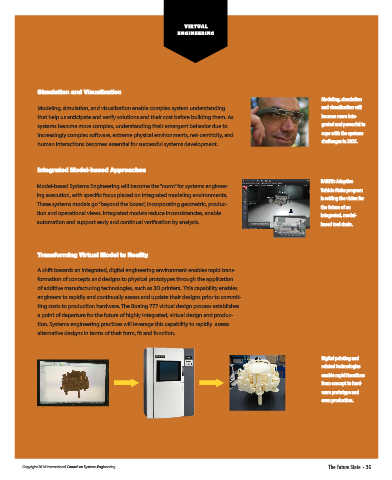
             A shift towards an integrated, digital engineering environment enables rapid trans-
             formation of concepts and designs to physical prototypes through the application
             of additive manufacturing technologies, such as 3D printers.  This capability enables
             engineers to rapidly and continually assess and update their designs prior to commit-
             ting costs to production hardware. The Boeing 777 virtual design process establishes
             a point of departure for the future of highly integrated, virtual design and produc-
             tion. Systems engineering practices will leverage this capability to rapidly  assess
             alternative designs in terms of their form, fit and function.


                                                                                                           Digital printing and
                                                                                                           related technologies
                                                                                                           enable rapid iterations
                                                                                                           from concept to hard-
                                                                                                           ware prototype and
                                                                                                           even production.


        Copyright 2014 International Council on Systems Engineering                                          The Future State  • 39

