


Page 14 - Data Structures Interactive Book
P. 14
Chapter 1


                  1.1  Basics of C++

                       C++ is a powerful, general-purpose programming language that evolved from C by

               adding  features  such  as  classes,  objects,  and  templates.  It  is  widely  used  in  system

               programming,  application  development,  and  performance-critical  software  because  of  its
               efficiency and flexibility. The basics of C++ involve understanding how to declare variables,

               apply data types, and control program execution. These elements form the foundation of

               every program, enabling developers to store information, make decisions, and repeat tasks.

               Mastering these basics ensures that students can progress confidently to advanced topics

               such as data structures and algorithms.


               1.1.1  Variables and Data Types

                       Variables  are  symbolic  names  that  represent  memory  locations  where  values  are

               stored. Each variable must be declared with a specific data type, which defines the kind of

               data it can hold and the operations that can be performed on it. C++ provides several primitive
               data  types  such  as  int  for  integers,  float  and  double  for  real  numbers,  char  for  single

               characters, and bool for logical values. Choosing the correct data type is essential for efficient

               memory usage and accurate computations. For example, integers are suitable for counting,
               while floating-point numbers are used for precise calculations involving fractions.

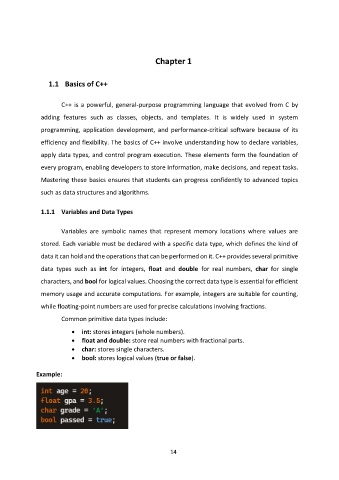
                       Common primitive data types include:

                          •  int: stores integers (whole numbers).
                          •  float and double: store real numbers with fractional parts.
                          •  char: stores single characters.
                          •  bool: stores logical values (true or false).

              Example:


                                                             14

