


Page 18 - Data Structures Interactive Book
P. 18
1.3.2  File Handling


                       File handling allows programs to store data permanently on disk and retrieve it when

               needed.  C++  provides  the  <fstream>  library,  which  includes  classes  such  as  ifstream  for

               reading files, ofstream for writing files, and fstream for both reading and writing. File handling

               is  essential  for  applications  that  require  persistent  storage,  such  as  databases  or  logging

               systems.
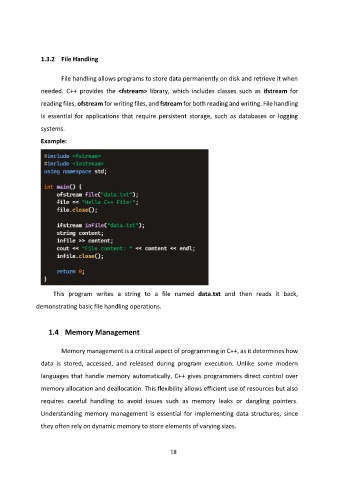
                 Example:


                         This  program  writes  a  string  to  a  file  named  data.txt  and  then  reads  it  back,
              demonstrating basic file handling operations.


                  1.4  Memory Management

                       Memory management is a critical aspect of programming in C++, as it determines how

               data  is  stored,  accessed,  and  released  during  program  execution.  Unlike  some  modern

               languages that handle memory automatically, C++  gives  programmers direct  control  over
               memory allocation and deallocation. This flexibility allows efficient use of resources but also

               requires  careful  handling  to  avoid  issues  such  as  memory  leaks  or  dangling  pointers.

               Understanding  memory  management  is  essential  for  implementing  data  structures,  since

               they often rely on dynamic memory to store elements of varying sizes.


                                                             18

