


Page 72 - Data Structures Interactive Book
P. 72
8.2 Representation of Graphs
Graphs can be represented in different ways depending on the application. The two
most common representations are adjacency matrices and adjacency lists.
8.2.1 Adjacency Matrix
An adjacency matrix is a two-dimensional array of size × , where is the number
of vertices in the graph. Each cell [ ][ ]indicates whether there is an edge between vertex
and vertex . For unweighted graphs, the value is typically 1 if an edge exists and 0 otherwise.
For weighted graphs, the cell stores the weight of the edge, and 0 or ∞ (infinity) indicates no
edge.
This representation is straightforward and allows constant-time edge lookup, which is
useful when checking whether two vertices are directly connected. However, it consumes
( )memory, which can be inefficient for sparse graphs with few edges compared to the
number of vertices.
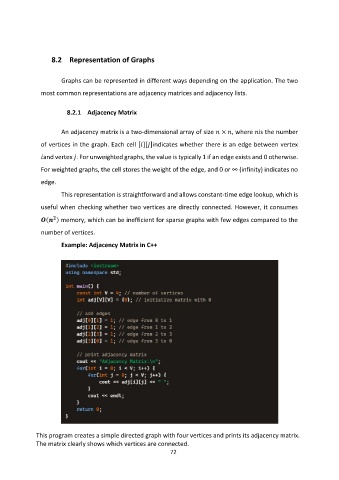
Example: Adjacency Matrix in C++
This program creates a simple directed graph with four vertices and prints its adjacency matrix.
The matrix clearly shows which vertices are connected.
72

