


Page 75 - Data Structures Interactive Book
P. 75
used traversal techniques are Breadth-First Search (BFS) and Depth-First Search (DFS). Each

               has unique characteristics and applications, and understanding both is essential for mastering

               graph algorithms.


                         8.3.1  Breadth-First Search (BFS)

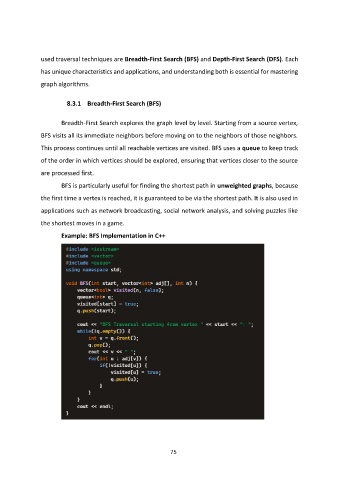
                       Breadth-First Search explores the graph level by level. Starting from a source vertex,

               BFS visits all its immediate neighbors before moving on to the neighbors of those neighbors.

               This process continues until all reachable vertices are visited. BFS uses a queue to keep track
               of the order in which vertices should be explored, ensuring that vertices closer to the source

               are processed first.

                       BFS is particularly useful for finding the shortest path in unweighted graphs, because

               the first time a vertex is reached, it is guaranteed to be via the shortest path. It is also used in

               applications such as network broadcasting, social network analysis, and solving puzzles like
               the shortest moves in a game.

                       Example: BFS Implementation in C++


                                                             75

