


Page 73 - Data Structures Interactive Book
P. 73
8.2.2  Adjacency List


                       An  adjacency  list  represents  the  graph  as  an  array  (or  vector)  of  lists.  Each  list

               corresponds to a vertex and contains all the vertices that are directly connected to it. This

               representation is more space-efficient for sparse graphs, as it only stores existing edges rather

               than all possible connections.

                       Adjacency lists are widely used in practice because they reduce memory usage and
               make traversal operations like BFS and DFS more efficient. However, checking whether two

               vertices are directly connected may take longer compared to adjacency matrices, since  it

               requires searching through a list.
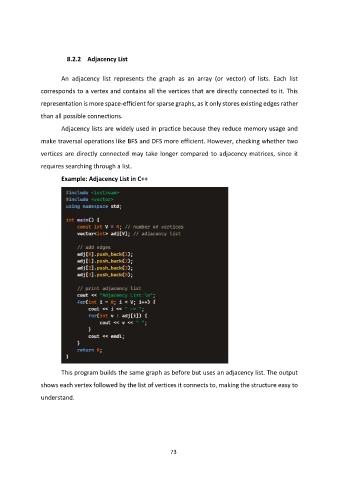
                       Example: Adjacency List in C++


                       This program builds the same graph as before but uses an adjacency list. The output

               shows each vertex followed by the list of vertices it connects to, making the structure easy to
               understand.


                                                             73

