


Page 115 - Data Structures Handout_Neat
P. 115
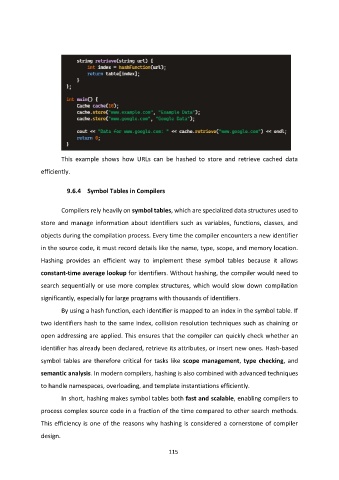
This  example  shows  how  URLs  can  be  hashed  to  store  and  retrieve  cached  data

               efficiently.


                         9.6.4  Symbol Tables in Compilers


                       Compilers rely heavily on symbol tables, which are specialized data structures used to
               store  and  manage  information about  identifiers  such  as  variables, functions,  classes,  and

               objects during the compilation process. Every time the compiler encounters a new identifier

               in the source code, it must record details like the name, type, scope, and memory location.
               Hashing  provides  an  efficient  way  to  implement  these  symbol  tables  because  it  allows

               constant-time average lookup for identifiers. Without hashing, the compiler would need to

               search sequentially or use more complex structures, which would slow down compilation

               significantly, especially for large programs with thousands of identifiers.

                       By using a hash function, each identifier is mapped to an index in the symbol table. If
               two identifiers hash to the same index, collision resolution techniques such as chaining or

               open addressing are applied. This ensures that the compiler can quickly check whether an

               identifier has already been declared, retrieve its attributes, or insert new ones. Hash-based
               symbol tables are therefore critical for tasks like  scope management, type checking, and

               semantic analysis. In modern compilers, hashing is also combined with advanced techniques

               to handle namespaces, overloading, and template instantiations efficiently.

                       In short, hashing makes symbol tables both fast and scalable, enabling compilers to
               process complex source code in a fraction of the time compared to other search methods.

               This efficiency is one of the reasons why hashing is considered a cornerstone of compiler

               design.


                                                            115

