


Page 10 - MAT KS3 Y8 Cambridge CheckPoint
P. 10
1.1 Arithmetic with integers


               1.1 Arithmetic with integers


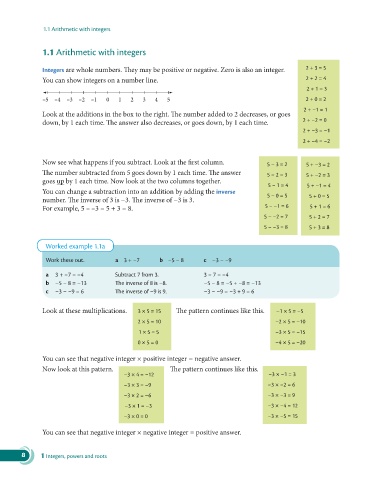
               Integers are whole numbers. They may be positive or negative. Zero is also an integer.    2 + 3 = 5
               You can show integers on a number line.                                                  2 + 2 = 4
                                                                                                         2 + 1 = 3
               –5  –4  –3  –2  –1    0   1   2   3   4   5                                              2 + 0 = 2
                                                                                                       2 + −1 = 1
               Look at the additions in the box to the right. The number added to 2 decreases, or goes
               down, by 1 each time. The answer also decreases, or goes down, by 1 each time.         2 + −2 = 0
                                                                                                      2 + −3 = −1
                                                                                                      2 + −4 = −2


               Now see what happens if you subtract. Look at the first column.             5 − 3 = 2   5 + −3 = 2
               The number subtracted from 5 goes down by 1 each time. The answer           5 − 2 = 3   5 + −2 = 3
               goes up by 1 each time. Now look at the two columns together.
                                                                                           5 − 1 = 4    5 + −1 = 4
               You can change a subtraction into an addition by adding the inverse
                                                                                           5 − 0 = 5     5 + 0 = 5
               number. The inverse of 3 is −3. The inverse of −3 is 3.
               For example, 5 – –3 = 5 + 3 = 8.                                           5 − −1 = 6     5 + 1 = 6
                                                                                         5 − −2 = 7      5 + 2 = 7
                                                                                         5 − −3 = 8      5 + 3 = 8


                Worked example 1.1a

                Work these out.         a  3 + −7     b  −5 − 8      c  −3 − −9

                a  3 + −7 = −4         Subtract 7 from 3.            3 − 7 = −4
                b  −5 − 8 = −13        The inverse of 8 is −8.       −5 − 8 = −5 + −8 = −13
                c  −3 − −9 = 6         The inverse of −9 is 9.       −3 − −9 = −3 + 9 = 6


               Look at these multiplications.   3 × 5 = 15  The pattern continues like this.   −1 × 5 = −5
                                               2 × 5 = 10                                    −2 × 5 = −10

                                                1 × 5 = 5                                    −3 × 5 = −15
                                               0 × 5 = 0                                     −4 × 5 = −20

               You can see that negative integer × positive integer = negative answer.
               Now look at this pattern.                  The pattern continues like this.
                                          −3 × 4 = −12                                     −3 × −1 = 3
                                          −3 × 3 = −9                                     −3 × −2 = 6
                                          −3 × 2 = −6                                     −3 × −3 = 9
                                           −3 × 1 = −3                                    −3 × −4 = 12
                                          −3 × 0 = 0                                      −3 × −5 = 15

               You can see that negative integer × negative integer = positive answer.


        8      1 Integers, powers and roots

