


Page 11 - MAT KS3 Y8 Cambridge CheckPoint
P. 11
1.1 Arithmetic with integers


               Here is a simple rule, which also works for division.
                                                                        When you multiply two integers:
                                                                        if they have same signs Æ positive answer
                                                                        if they have different signs Æ negative answer

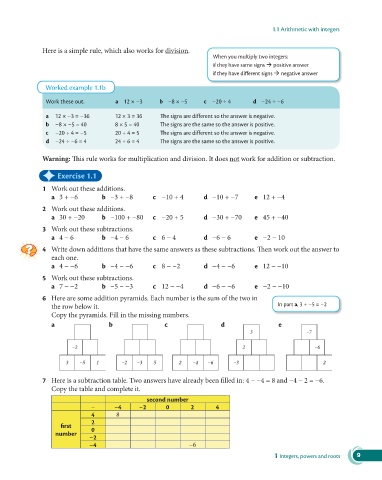
                Worked example 1.1b

                Work these out.         a  12 × −3    b  −8 × −5     c −20 ÷ 4       d −24 ÷ −6

                a  12 × −3 = −36       12 × 3 = 36    The signs are different so the answer is negative.
                b  −8 × −5 = 40        8 × 5 = 40     The signs are the same so the answer is positive.
                c  −20 ÷ 4 = −5        20 ÷ 4 = 5     The signs are different so the answer is negative.
                d  −24 ÷ −6 = 4        24 ÷ 6 = 4     The signs are the same so the answer is positive.

               Warning: This rule works for multiplication and division. It does not work for addition or subtraction.

               ✦     Exercise 1.1


               1  Work out these additions.
                  a  3 + −6        b −3 + −8        c −10 + 4        d −10 + −7       e 12 + −4

               2  Work out these additions.
                  a  30 + −20      b −100 + −80     c −20 + 5        d −30 + −70      e 45 + −40
               3  Work out these subtractions.
                  a  4 − 6         b −4 − 6         c 6 − 4          d −6 − 6         e −2 − 10
               4   Write down additions that have the same answers as these subtractions. Then work out the answer to
                  each one.
                  a  4 − −6        b −4 − −6        c 8 − −2         d −4 − −6        e 12 − −10
               5  Work out these subtractions.
                  a  7 − −2        b −5 − −3        c 12 − −4        d −6 − −6        e −2 − −10

               6  Here are some addition pyramids. Each number is the sum of the two in
                  the row below it.                                                           In part a, 3 + −5 = −2
                  Copy the pyramids. Fill in the missing numbers.
                  a                  b                   c                 d                  e
                                                                                    3                  –7


                         –2                                                       2                       –6

                       3    –5   1        –2   –3   5        2   –4   –6       –3                            2

               7  Here is a subtraction table. Two answers have already been filled in: 4 − −4 = 8 and −4 − 2 = −6.
                  Copy the table and complete it.
                                                  second number
                               −       −4      −2       0        2       4
                                4       8
                                2
                     first
                                0
                   number
                               −2
                               −4                               −6
                                                                                             1 Integers, powers and roots  9

