


Page 15 - MAT KS3 Y8 Cambridge CheckPoint
P. 15
1.3 More about prime numbers


               1.3 More about prime numbers


               Any integer bigger than 1, that is not prime, can be written as a product of prime numbers.
               Here are some examples.
               84 = 2 × 2 × 3 × 7    45 = 3 × 3 × 5    196 = 2 × 2 × 7 × 7
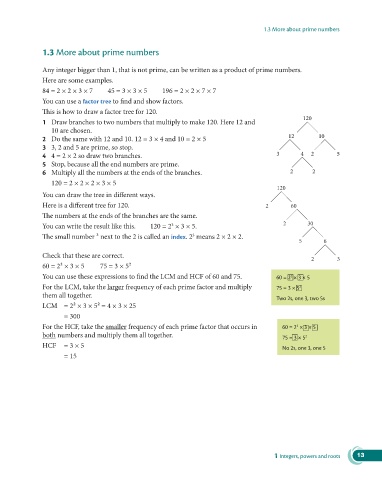
               You can use a factor tree to find and show factors.

               This is how to draw a factor tree for 120.
                                                                                                      120
               1   Draw branches to two numbers that multiply to make 120. Here 12 and
                  10 are chosen.
               2  Do the same with 12 and 10. 12 = 3 × 4 and 10 = 2 × 5                          12        10
               3  3, 2 and 5 are prime, so stop.
               4  4 = 2 × 2 so draw two branches.                                            3       4   2       5
               5  Stop, because all the end numbers are prime.
               6  Multiply all the numbers at the ends of the branches.                           2      2

                  120 = 2 × 2 × 2 × 3 × 5
                                                                                             120
               You can draw the tree in different ways.
               Here is a different tree for 120.                                          2       60
               The numbers at the ends of the branches are the same.
                                                          3
               You can write the result like this.   120 = 2  × 3 × 5.                          2       30
               The small number 3 next to the 2 is called an index. 2  means 2 × 2 × 2.
                                                                 3
                                                                                                     5       6
               Check that these are correct.
                                                                                                         2        3
               60 = 22 × 3 × 5    75 = 3 × 52
               You can use these expressions to find the LCM and HCF of 60 and 75.           60 = 2  × 3 × 5
                                                                                                  2
               For the LCM, take the larger frequency of each prime factor and multiply      75 = 3 × 5 2
               them all together.
                                                                                             Two 2s, one 3, two 5s
               LCM  = 22 × 3 × 52 = 4 × 3 × 25
                      = 300
               For the HCF, take the smaller frequency of each prime factor that occurs in     60 = 2  × 3 × 5
                                                                                                    2
               both numbers and multiply them all together.                                    75 = 3 × 5 2
               HCF  = 3 × 5                                                                    No 2s, one 3, one 5

                      = 15


                                                                                             1 Integers, powers and roots  13

