


Page 101 - MAT KS3 Y8 Cambridge CheckPoint
P. 101
9.3 Constructing and solving equations


               9.3 Constructing and solving equations


               When you are given a problem to solve, you may need to construct, or write, an equation to help you
               solve the problem.


                Worked example 9.3
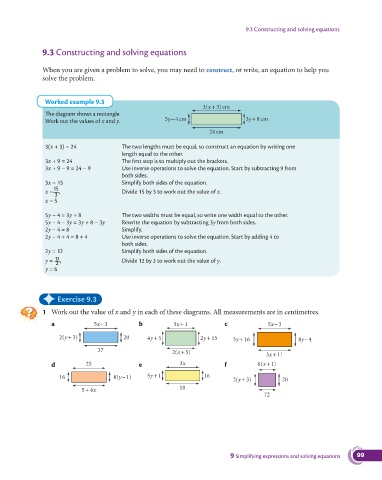
                                                                     3(x + 3) cm
                The diagram shows a rectangle.
                                                        5y – 4 cm                  3y + 8 cm
                Work out the values of x and y.
                                                                       24 cm

                3(x + 3) = 24               The two lengths must be equal, so construct an equation by writing one
                                          length equal to the other.
                3x + 9 = 24                 The first step is to multiply out the brackets.
                3x + 9 − 9 = 24 − 9       Use inverse operations to solve the equation. Start by subtracting 9 from
                                          both sides.
                3x = 15                   Simplify both sides of the equation.
                   15
                x = ,                     Divide 15 by 3 to work out the value of x.
                   3
                x = 5
                5y − 4 = 3y + 8             The two widths must be equal, so write one width equal to the other.
                5y − 4 − 3y = 3y + 8 − 3y     Rewrite the equation by subtracting 3y from both sides.
                2y − 4 = 8                Simplify.
                2y − 4 + 4 = 8 + 4          Use inverse operations to solve the equation. Start by adding 4 to
                                          both sides.
                2y = 12                     Simplify both sides of the equation.
                   12
                y =  ,                    Divide 12 by 2 to work out the value of y.
                    2
                y = 6

               ✦     Exercise 9.3


               1  Work out the value of x and y in each of these diagrams. All measurements are in centimetres.

                  a             5x – 3         b           3x + 1           c             5x – 3

                     2(y + 3)             20      4y + 5            2y + 15    3y + 16               8y – 4
                                  37                      2(x + 5)                        3x + 11

                  d           25              e              3x             f          6(x + 1)

                     16                8(y – 1)   5y + 1             16
                                                                               2(y + 3)        20
                            5 + 4x                           18
                                                                                         72


                                                                              9 Simplifying expressions and solving equations  99

