


Page 123 - MAT KS3 Y8 Cambridge CheckPoint
P. 123
12.1 Drawing circles and arcs


               12.1 Drawing circles and arcs


               You must always use a pair of compasses to draw a circle or an arc accurately.
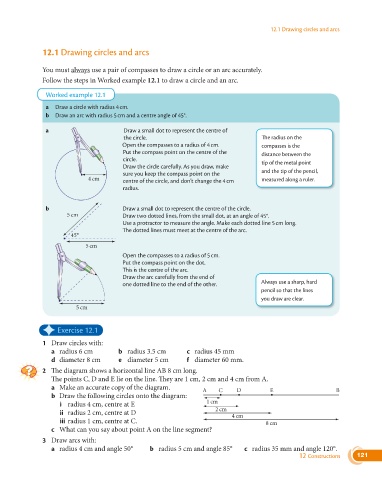
               Follow the steps in Worked example 12.1 to draw a circle and an arc.

                Worked example 12.1

                a  Draw a circle with radius 4 cm.
                b  Draw an arc with radius 5 cm and a centre angle of 45°.

                a                           Draw a small dot to represent the centre of
                                          the circle.                                   The radius on the
                                          Open the compasses to a radius of 4 cm.       compasses is the
                                            Put the compass point on the centre of the
                                                                                        distance between the
                                          circle.
                                                                                        tip of the metal point
                                            Draw the circle carefully. As you draw, make
                                                                                        and the tip of the pencil,
                                          sure you keep the compass point on the
                              4 cm        centre of the circle, and don’t change the 4 cm   measured along a ruler.
                                          radius.


                b                         Draw a small dot to represent the centre of the circle.
                       5 cm               Draw two dotted lines, from the small dot, at an angle of 45°.
                                          Use a protractor to measure the angle. Make each dotted line 5 cm long.
                                          The dotted lines must meet at the centre of the arc.
                         45°

                              5 cm
                                          Open the compasses to a radius of 5 cm.
                                          Put the compass point on the dot.
                                          This is the centre of the arc.
                                          Draw the arc carefully from the end of
                                                                                        Always use a sharp, hard
                                          one dotted line to the end of the other.
                                                                                        pencil so that the lines
                                                                                        you draw are clear.
                          5 cm

               ✦     Exercise 12.1


               1  Draw circles with:
                  a  radius 6 cm         b radius 3.5 cm       c radius 45 mm
                  d  diameter 8 cm       e diameter 5 cm       f diameter 60 mm.
               2  The diagram shows a horizontal line AB 8 cm long.
                  The points C, D and E lie on the line. They are 1 cm, 2 cm and 4 cm from A.
                  a  Make an accurate copy of the diagram.
                                                                     A    C     D          E                     B
                  b  Draw the following circles onto the diagram:
                     i  radius 4 cm, centre at E                      1 cm
                                                                         2 cm
                     ii  radius 2 cm, centre at D
                                                                              4 cm
                     iii radius 1 cm, centre at C.                                        8 cm
                  c  What can you say about point A on the line segment?
               3  Draw arcs with:
                  a  radius 4 cm and angle 50°     b radius 5 cm and angle 85°     c radius 35 mm and angle 120°.
                                                                                                     12 Constructions   121

