


Page 126 - MAT KS3 Y8 Cambridge CheckPoint
P. 126
12.3 Drawing an angle bisector


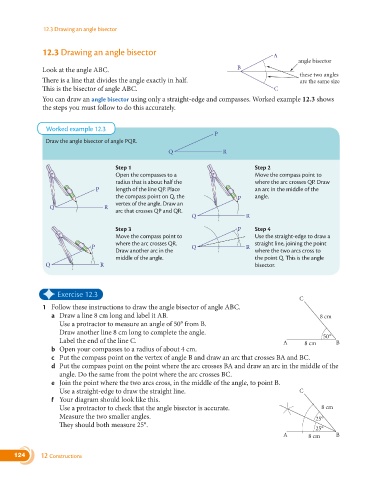
               12.3 Drawing an angle bisector
                                                                                            A
                                                                                                     angle bisector
               Look at the angle ABC.                                           B
                                                                                                     these two angles
               There is a line that divides the angle exactly in half.                               are the same size
               This is the bisector of angle ABC.                                            C
               You can draw an angle bisector using only a straight-edge and compasses. Worked example 12.3 shows
               the steps you must follow to do this accurately.


                Worked example 12.3
                                                                         P
                Draw the angle bisector of angle PQR.
                                                         Q                 R

                                        Step 1                                        Step 2
                                          Open the compasses to a                       Move the compass point to
                                        radius that is about half the                 where the arc crosses QP. Draw
                                 P      length of the line QP. Place                  an arc in the middle of the
                                        the compass point on Q, the             P     angle.
                                        vertex of the angle. Draw an
                  Q                 R
                                        arc that crosses QP and QR.
                                                                 Q                 R
                                        Step 3                                  P     Step 4
                                          Move the compass point to                     Use the straight-edge to draw a
                                        where the arc crosses QR.                     straight line, joining the point
                                P                                Q                 R
                                        Draw another arc in the                       where the two arcs cross to
                                        middle of the angle.                          the point Q. This is the angle
                Q                 R                                                   bisector.


               ✦     Exercise 12.3                                                                   C

               1  Follow these instructions to draw the angle bisector of angle ABC.
                  a  Draw a line 8 cm long and label it AB.                                                 8 cm
                    Use a protractor to measure an angle of 50° from B.
                    Draw another line 8 cm long to complete the angle.
                                                                                                             50 °
                    Label the end of the line C.                                                A      8 cm      B
                  b  Open your compasses to a radius of about 4 cm.
                  c  Put the compass point on the vertex of angle B and draw an arc that crosses BA and BC.
                  d   Put the compass point on the point where the arc crosses BA and draw an arc in the middle of the
                     angle. Do the same from the point where the arc crosses BC.
                  e   Join the point where the two arcs cross, in the middle of the angle, to point B.
                     Use a straight-edge to draw the straight line.                                  C
                  f  Your diagram should look like this.
                    Use a protractor to check that the angle bisector is accurate.                          8 cm
                    Measure the two smaller angles.                                                       25°
                    They should both measure 25°.
                                                                                                          25°
                                                                                                A       8 cm     B


      124      12 Constructions

