


Page 168 - MAT KS3 Y8 Cambridge CheckPoint
P. 168
17.1 The area of a triangle


               17.1 The area of a triangle                                      surrounding
                                                                                rectangle

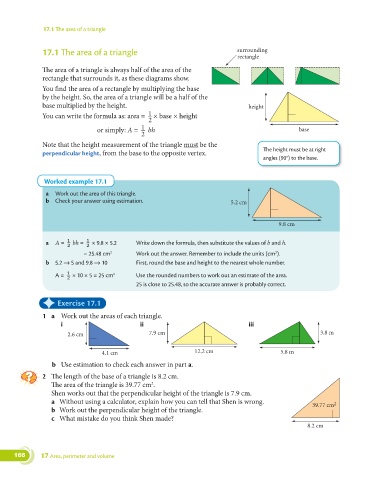
               The area of a triangle is always half of the area of the
               rectangle that surrounds it, as these diagrams show.
               You find the area of a rectangle by multiplying the base
               by the height. So, the area of a triangle will be a half of the
               base multiplied by the height.                                       height
                                                   1
               You can write the formula as: area =  × base × height
                                                   2
                                                1
                                 or  simply:  A =   bh                                               base
                                                2
               Note that the height measurement of the triangle must be the
                                                                                         The height must be at right
               perpendicular height, from the base to the opposite vertex.
                                                                                         angles (90°) to the base.


                Worked example 17.1

                a  Work out the area of this triangle.
                b  Check your answer using estimation.                        5.2 cm


                                                                                              9.8 cm


                        1     1
                a  A =   bh =   × 9.8 × 5.2    Write down the formula, then substitute the values of b and h.
                       2      2
                             = 25.48 cm       Work out the answer. Remember to include the units (cm ).
                                      2
                                                                                             2
                b 5.2 → 5 and 9.8 → 10        First, round the base and height to the nearest whole number.
                       1
                                       2
                   A =    × 10 × 5 = 25 cm    Use the rounded numbers to work out an estimate of the area.
                       2
                                              25 is close to 25.48, so the accurate answer is probably correct.
                     Exercise 17.1

               1 a  Work out the areas of each triangle.
                     i                          ii                                  iii
                        2.6 cm                     7.9 cm                                                   3.8 m


                                   4.1 cm                         12.2 cm                      5.8 m
                  b  Use estimation to check each answer in part a.

               2  The length of the base of a triangle is 8.2 cm.
                                                    2
                  The area of the triangle is 39.77 cm .
                  Shen works out that the perpendicular height of the triangle is 7.9 cm.
                  a  Without using a calculator, explain how you can tell that Shen is wrong.
                                                                                                         39.77 cm 2
                  b  Work out the perpendicular height of the triangle.
                  c  What mistake do you think Shen made?
                                                                                                        8.2 cm


      166      17 Area, perimeter and volume
      166

