


Page 169 - MAT KS3 Y8 Cambridge CheckPoint
P. 169
17.2 The areas of a parallelogram and trapezium


               17.2 The areas of a parallelogram and trapezium


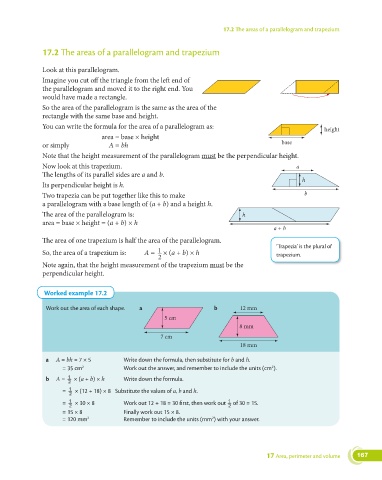
               Look at this parallelogram.
               Imagine you cut off the triangle from the left end of
               the parallelogram and moved it to the right end. You
               would have made a rectangle.
               So the area of the parallelogram is the same as the area of the
               rectangle with the same base and height.
               You can write the formula for the area of a parallelogram as:
                                                                                                             height
                                   area = base × height
                                                                                               base
               or simply             A = bh
               Note that the height measurement of the parallelogram must be the perpendicular height.
               Now look at this trapezium.                                                          a
               The lengths of its parallel sides are a and b.
                                                                                                      h
               Its perpendicular height is h.
               Two trapezia can be put together like this to make                                      b
               a parallelogram with a base length of (a + b) and a height h.
               The area of the parallelogram is:                                  h
               area = base × height = (a + b) × h
                                                                                            a + b
               The area of one trapezium is half the area of the parallelogram.
                                                                                             ‘Trapezia’ is the plural of
                                                      1
               So, the area of a trapezium is:   A =  × (a + b) × h
                                                      2                                      trapezium.
               Note again, that the height measurement of the trapezium must be the
               perpendicular height.


                Worked example 17.2


                Work out the area of each shape.     a                   b       12 mm
                                                        5 cm
                                                                                 8 mm

                                                       7 cm
                                                                                 18 mm

                a  A = bh = 7 × 5         Write down the formula, then substitute for b and h.
                            2
                                                                                            2
                      = 35 cm             Work out the answer, and remember to include the units (cm ).
                        1
                b  A =   × (a + b) × h      Write down the formula.
                        2
                        1
                      =    × (12 + 18) × 8  Substitute the values of a, b and h.
                        2
                        1                                                    1
                      =    × 30 × 8       Work out 12 + 18 = 30 first, then work out   of 30 = 15.
                        2                                                    2
                      = 15 × 8            Finally work out 15 × 8.
                                                                        2
                              2
                      = 120 mm            Remember to include the units (mm ) with your answer.

                                                                                          17 Area, perimeter and volume  167

