


Page 3 - IDX-DecisionTree-Booklet-Digital
P. 3
Overview & Rationale:

        Biofilm Ecology and Oral Health


        Subgingival Biofilm Complexes
        According to Socransky’s classification, the subgingival
        biofilm can be grouped into distinct “color-coded” microbial
        complexes that reflect virulence, colonization sequence, and
        disease progression.


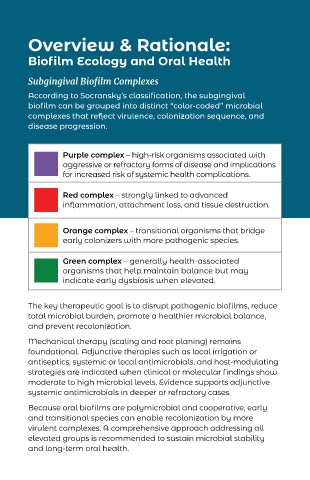
                 Purple complex – high-risk organisms associated with
                 aggressive or refractory forms of disease and implications
                 for increased risk of systemic health complications.

                 Red complex – strongly linked to advanced
                 inflammation, attachment loss, and tissue destruction.


                 Orange complex – transitional organisms that bridge
                 early colonizers with more pathogenic species.

                 Green complex – generally health-associated
                 organisms that help maintain balance but may
                 indicate early dysbiosis when elevated.


        The key therapeutic goal is to disrupt pathogenic biofilms, reduce
        total microbial burden, promote a healthier microbial balance,
        and prevent recolonization.

        Mechanical therapy (scaling and root planing) remains
        foundational. Adjunctive therapies such as local irrigation or
        antiseptics, systemic or local antimicrobials, and host-modulating
        strategies are indicated when clinical or molecular findings show
        moderate to high microbial levels. Evidence supports adjunctive
        systemic antimicrobials in deeper or refractory cases.
        Because oral biofilms are polymicrobial and cooperative, early
        and transitional species can enable recolonization by more
        virulent complexes. A comprehensive approach addressing all
        elevated groups is recommended to sustain microbial stability
        and long-term oral health.

