


Page 34 - Avoid Food and Drug Interactions
P. 34
Parenteral Nutrition: Then vs Now

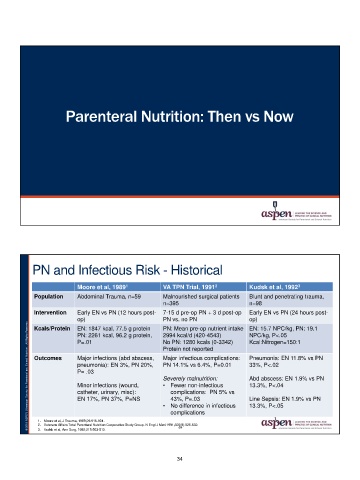
                                                                                            PN and Infectious Risk - Historical

                                                                                                      Moore et al, 19891                           VA TPN Trial, 19912                                 Kudsk et al, 19923

                                                                                            Population Abdominal Trauma, n=59                      Malnourished surgical patients Blunt and penetrating trauma,

                                                                                                                                                   n=395                                               n=98

                                                                                            Intervention Early EN vs PN (12 hours post- 7-15 d pre-op PN + 3 d post-op Early EN vs PN (24 hours post-

© 2019 ASPEN | American Society for Parenteral and Enteral Nutrition. All Rights Reserved.            op)                                          PN vs. no PN                                        op)

                                                                                            Kcals/Protein EN: 1847 kcal, 77.5 g protein            PN: Mean pre-op nutrient intake                     EN: 15.7 NPC/kg, PN: 19.1
                                                                                                                   PN: 2261 kcal, 96.2 g protein,  2994 kcal/d (420-4543)                              NPC/kg, P<.05
                                                                                                                   P=.01                           No PN: 1280 kcals (0-3342)                          Kcal:Nitrogen=150:1
                                                                                                                                                   Protein not reported

                                                                                            Outcomes  Major infections (abd abscess,               Major infectious complications:                     Pneumonia: EN 11.8% vs PN
                                                                                                      pneumonia): EN 3%, PN 20%,                   PN 14.1% vs 6.4%, P=0.01                            33%, P<.02
                                                                                                      P= .03
                                                                                                                                                   Severely malnutrition:                              Abd abscess: EN 1.9% vs PN
                                                                                                      Minor infections (wound,                     • Fewer non-infectious                              13.3%, P<.04
                                                                                                      catheter, urinary, misc):
                                                                                                      EN 17%, PN 37%, P=NS                             complications: PN 5% vs                         Line Sepsis: EN 1.9% vs PN
                                                                                                                                                       43%, P=.03                                      13.3%, P<.05
                                                                                                                                                   • No difference in infectious
                                                                                                                                                       complications

                                                                                            1. Moore et al, J Trauma, 1989;29:916-924 .

                                                                                            2. Veterans Affairs Total Parenteral Nutrition Cooperative Study Group. N Engl J Med.1991;325(8):525-532.
                                                                                                                                                   64
                                                                                            3. Kudsk et al, Ann Surg, 1992;215:503-513.

                                                                                                                                                   34

