


Page 36 - Avoid Food and Drug Interactions
P. 36
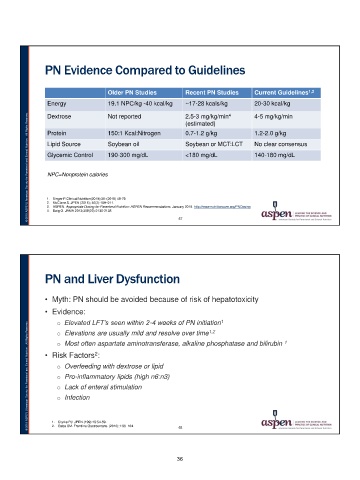
PN Evidence Compared to Guidelines

© 2019 ASPEN | American Society for Parenteral and Enteral Nutrition. All Rights Reserved.  Energy                   Older PN Studies                 Recent PN Studies                                                        Current Guidelines1,2
                                                                                            Dextrose                 19.1 NPC/kg -40 kcal/kg          ~17-28 kcals/kg                                                          20-30 kcal/kg
                                                                                                                     Not reported                                                                                              4-5 mg/kg/min
                                                                                            Protein                                                   2.5-3 mg/kg/min4
                                                                                            Lipid Source             150:1 Kcal:Nitrogen              (estimated)                                                              1.2-2.0 g/kg
                                                                                            Glycemic Control         Soybean oil                      0.7-1.2 g/kg                                                             No clear consensus
                                                                                                                     190-300 mg/dL                    Soybean or MCT:LCT                                                       140-180 mg/dL
                                                                                                                                                      <180 mg/dL

                                                                                            NPC=Nonprotein calories

                                                                                            1. Singer P.Clinical Nutrition(2019);38 :(2019) 48-79.
                                                                                            2. McClave S. JPEN (2016); 40(2):159–211.
                                                                                            3. ASPEN. Appropriate Dosing for Parenteral Nutrition: ASPEN Recommendations. January 2019. http://www.nutritioncare.org/PNDosing
                                                                                            4. Doig G. JAMA.2013;309(20):2130-2138.

                                                                                                                                                                                                                  67

© 2019 ASPEN | American Society for Parenteral and Enteral Nutrition. All Rights Reserved.  PN and Liver Dysfunction

                                                                                            • Myth: PN should be avoided because of risk of hepatotoxicity
                                                                                            • Evidence:

                                                                                                 o Elevated LFT’s seen within 2-4 weeks of PN initiation1
                                                                                                 o Elevations are usually mild and resolve over time1,2
                                                                                                 o Most often aspartate aminotransferase, alkaline phosphatase and bilirubin 1

                                                                                            • Risk Factors2:

                                                                                                 o Overfeeding with dextrose or lipid
                                                                                                 o Pro-inflammatory lipids (high n6:n3)
                                                                                                 o Lack of enteral stimulation
                                                                                                 o Infection

                                                                                            1. Clarke PJ. JPEN.(199):15:54-59.                    68
                                                                                            2. Gabe SM. Frontline Gastroentero. (2010);1:98–104.

                                                                                                                                                  36

