


Page 60 - Seametrics Product Catalog 2015_062415
P. 60
MJ-SERIES
Pulse Meter

FEATURES
• Dry top multi-jet design
• Tolerates low quality water
• Simple pulse output
• Cold or hot water models

APPLICATIONS
• Cooling tower chemical control
• Industrial water treatment
• Deduct metering

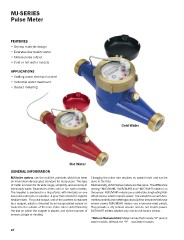
                                                                    Cold Water

                                  Hot Water

GENERAL INFORMATION                                                 Changing the pulse rate requires no special tools and can be
                                                                    done in the field.
MJ-Series meters use the multi-jet principle, which has been        Mechanically, all MJ-Series meters are the same. The difference
an internationally-accepted standard for many years. This type      among *MJE/MJHE, *MJR/MJHR and *MJT/MJHT meters is in
of meter is known for its wide range, simplicity, and accuracy in   the sensor. MJE/MJHE meters use a solid-state, long-lasting Hall-
low-quality water. Seametrics offers cold or hot water models.      effect sensor, which requires power. It is suited for use with Sea-
The impeller is centered in a ring of jets, with inlet jets on one  metrics controls and metering pumps (LMI for instance) that have
level and outlet jets on another. A gear train drives the register  sensor power. MJR/MJHR meters use a two-wire reed switch.
totalizer dials. For pulse output, one of the pointers is replaced  They provide a dry contact closure and do not require power.
by a magnet, which is detected by an encapsulated sensor at-        MJT/MJHT meters totalize only and do not have a sensor.
tached to the outside of the lens. Pulse rate is determined by      *Note on Nomenclature: Meter names that include “H” are hot
the dial on which the magnet is placed, and by the number of        water models. Without the “H” = cold water models.
sensors (single or double).

47

