


Page 64 - Seametrics Product Catalog 2015_062415
P. 64
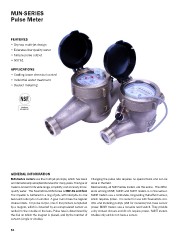
MJN-SERIES
Pulse Meter

FEATURES
• Dry top multi-jet design
• Tolerates low quality water
• Simple pulse output
• NSF61

APPLICATIONS
• Cooling tower chemical control
• Industrial water treatment
• Deduct metering

    NSF®

                   Certified to
                  NSF/ANSI 61

GENERAL INFORMATION                                                  Changing the pulse rate requires no special tools and can be
                                                                     done in the field.
MJN-Series meters use the multi-jet principle, which has been        Mechanically, all MJN-Series meters are the same. The differ-
an internationally-accepted standard for many years. This type of    ence among MJNE, MJNR and MJNT meters is in the sensor.
meter is known for its wide range, simplicity, and accuracy in low-  MJNE meters use a solid-state, long-lasting Hall-effect sensor,
quality water. The Seametrics MJN-Series is NSF-61 certified.        which requires power. It is suited for use with Seametrics con-
The impeller is centered in a ring of jets, with inlet jets on one   trols and metering pumps (LMI for instance) that have sensor
level and outlet jets on another. A gear train drives the register   power. MJNR meters use a two-wire reed switch. They provide
totalizer dials. For pulse output, one of the pointers is replaced   a dry contact closure and do not require power. MJNT meters
by a magnet, which is detected by an encapsulated sensor at-         totalize only and do not have a sensor.
tached to the outside of the lens. Pulse rate is determined by
the dial on which the magnet is placed, and by the number of
sensors (single or double).

51

