Page 57 - moondani kyema
P. 57
ndani kyema, My Story - Ray Moore 57
Although the War was over, the school was never to be a truly ‘Chefoo’ school again,
although the name was carried on for many years in other places and other
countries. It had enjoyed a long and distinguished history from the latter part of the
19th century until the middle of the 20th. The Boys School for instance was used by
the CIM from 1896 until early 1942 when we were interned by the Japanese. On VJ
Day in August 1945 the Communist troops took over the property.
We are indebted to Candida Battistuzi, an Italian citizen who had been interned by
the Japanese in the latter part of the Second World War, for leaving us the following
account of the end of the Boys School building:
“ We saw some ‘comrades’ running around in the school. We found out later
that they were chasing some poor fugitive. Since it was night time they lit
some straw as torches in order to find their way around. When the ‘comrades’
got tired of looking for their man they just threw down the torches and left. The
torches ignited the straw, which in turn ignited some grenades which the
Japanese had left behind. That is how the Boys’ School burned down.”
At the end of 1946, after a year’s break, the Chefoo School reinvented itself in
Shanghai. We were housed in the CIM headquarters which consisted of two large
buildings separated from each other by lawn and gardens. One of the buildings was
used as a storage room for missionaries' belongings and for accommodation for the
staff, and for missionaries who were passing through to their stations or going home
to their home countries.
The other building was used by the business department and also had a meeting hall
on the ground floor which was usually called "The Prayer Room". It was in this
building that the school was set up again as a boarding school.
The China Inland Mission was a "Faith Mission" and did not advertise for finances.
Prayer and personal devotion were high on the agenda for both the missionaries and
the residents of the boarding school. So the Prayer
Room was an important part of the structure of the
Mission Headquarters.
This Prayer Room, which Bev and I visited in 1999
(Picture shows me standing at the door to the Prayer
Room) also played an important part in the lives of our
family.
My parents were married there in 1934, and, in 1947,
after hearing an inspiring talk given to the children, I
went to this place alone and gave my life to the Lord.
Prayer Room The school was given the top two floors of the building
and it was soon set up as the new Chefoo School.
On our 1999 visit, the building was the main Children's Hospital for Shanghai. After
we entered the property I was able very quickly to identify the Prayer Room. We
managed to persuade a staff member to get a key to the Prayer Room and inside
Although the War was over, the school was never to be a truly ‘Chefoo’ school again,
although the name was carried on for many years in other places and other
countries. It had enjoyed a long and distinguished history from the latter part of the
19th century until the middle of the 20th. The Boys School for instance was used by
the CIM from 1896 until early 1942 when we were interned by the Japanese. On VJ
Day in August 1945 the Communist troops took over the property.
We are indebted to Candida Battistuzi, an Italian citizen who had been interned by
the Japanese in the latter part of the Second World War, for leaving us the following
account of the end of the Boys School building:
“ We saw some ‘comrades’ running around in the school. We found out later
that they were chasing some poor fugitive. Since it was night time they lit
some straw as torches in order to find their way around. When the ‘comrades’
got tired of looking for their man they just threw down the torches and left. The
torches ignited the straw, which in turn ignited some grenades which the
Japanese had left behind. That is how the Boys’ School burned down.”
At the end of 1946, after a year’s break, the Chefoo School reinvented itself in
Shanghai. We were housed in the CIM headquarters which consisted of two large
buildings separated from each other by lawn and gardens. One of the buildings was
used as a storage room for missionaries' belongings and for accommodation for the
staff, and for missionaries who were passing through to their stations or going home
to their home countries.
The other building was used by the business department and also had a meeting hall
on the ground floor which was usually called "The Prayer Room". It was in this
building that the school was set up again as a boarding school.
The China Inland Mission was a "Faith Mission" and did not advertise for finances.
Prayer and personal devotion were high on the agenda for both the missionaries and
the residents of the boarding school. So the Prayer
Room was an important part of the structure of the
Mission Headquarters.
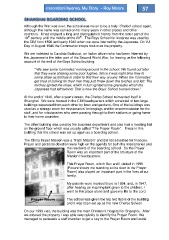
This Prayer Room, which Bev and I visited in 1999
(Picture shows me standing at the door to the Prayer
Room) also played an important part in the lives of our
family.
My parents were married there in 1934, and, in 1947,
after hearing an inspiring talk given to the children, I
went to this place alone and gave my life to the Lord.
Prayer Room The school was given the top two floors of the building
and it was soon set up as the new Chefoo School.
On our 1999 visit, the building was the main Children's Hospital for Shanghai. After
we entered the property I was able very quickly to identify the Prayer Room. We
managed to persuade a staff member to get a key to the Prayer Room and inside