Page 58 - moondani kyema
P. 58
ndani kyema, My Story - Ray Moore 58
found that it was little changed from 1947. I took some footage with my video camera.
Unfortunately it soon became apparent that we were not welcome there as music
was turned up loud and the staff member who let us in was obviously in trouble. We
left gracefully and went around to the outside of the Prayer Room and took some
more pictures.
Once known as "The Paris of the East," Shanghai in the early 20th century laid claim
to being the most glamorous, decadent and cultured city in China—and all of Asia.
Unlike Beijing, Shanghai's history does not date far back. Until 1842 it was a sleepy
fishing village. Shanghai, in Chinese, means on the sea. Its advantageous location,
on the banks of the Yangtze (Chang Jiang) River delta, close to the silk and tea
producing regions of China, soon propelled it to prominence.
The 1842 Opium Wars are central to Shanghai's origins as a cosmopolitan
destination. To even out the trade imbalance between England and China, England
began importing Indian opium to China, against the wishes of the Qing imperial court.
Unable to stop the opium trade, which was quickly affecting every social class in
China, the Qing declared war on opium traders. The English quickly won the war and
as indemnity the Qing were required to
open Shanghai to foreign merchants. I think
that this must be one of the most shameful
incidents of British colonial history.
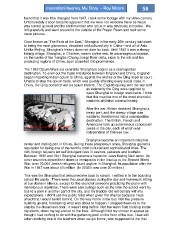
Opium Den in Shanghai 1907 After the war, Britain declared Shanghai a
treaty port, and the sleepy village was
suddenly transformed into a cosmopolitan
destination. The British, French and
Americans took up autonomous concession
zones in the city, each of which was
independent of Chinese law.
Shanghai became an important industrial
center and trading port in China. During these prosperous times, Shanghai gained a
reputation for being one of the world's most cultured and sophisticated cities. The
rich, foreign tai pans led self-indulgent lives in casinos, cabarets and brothels.
Between 1931 and 1941 Shanghai became a haven for Jews fleeing Nazi terror. As
other countries closed their doors to immigrants in the lead up to the Second World
War, over 20,000 Jewish refugees found asylum in Shanghai. Its population after the
War in 1947 was about 4½ million. (In 2003 it was over 20 million.)
This was the Shanghai that welcomed me back to school. I settled in to the boarding
school life easily. There were the usual classes during the day and homework sitting
at our desks in silence, except for the sound of someone practicing the piano with
monotonous repetition. There were also outings such as the time the school went by
bus to a park in another part of the city, and my bladder did not comply with my
expectations. I didn't use the public toilet when given the chance because I was
afraid that I would be left behind. On the way home in the bus I felt the pressure
building up and, forecasting what was about to happen, I stepped down on to the
step by the closed exit door. It wasn't long before I felt the warm fluid trickling inside
my shorts, down my leg and on to the floor. Although I did my utmost to appear as
though I had nothing to do with the gathering pool on the floor of the bus, I was still
taken aside by one of the teachers when we got home, who suggested to me that
found that it was little changed from 1947. I took some footage with my video camera.
Unfortunately it soon became apparent that we were not welcome there as music
was turned up loud and the staff member who let us in was obviously in trouble. We
left gracefully and went around to the outside of the Prayer Room and took some
more pictures.
Once known as "The Paris of the East," Shanghai in the early 20th century laid claim
to being the most glamorous, decadent and cultured city in China—and all of Asia.
Unlike Beijing, Shanghai's history does not date far back. Until 1842 it was a sleepy
fishing village. Shanghai, in Chinese, means on the sea. Its advantageous location,
on the banks of the Yangtze (Chang Jiang) River delta, close to the silk and tea
producing regions of China, soon propelled it to prominence.
The 1842 Opium Wars are central to Shanghai's origins as a cosmopolitan
destination. To even out the trade imbalance between England and China, England
began importing Indian opium to China, against the wishes of the Qing imperial court.
Unable to stop the opium trade, which was quickly affecting every social class in
China, the Qing declared war on opium traders. The English quickly won the war and
as indemnity the Qing were required to
open Shanghai to foreign merchants. I think
that this must be one of the most shameful
incidents of British colonial history.
Opium Den in Shanghai 1907 After the war, Britain declared Shanghai a
treaty port, and the sleepy village was
suddenly transformed into a cosmopolitan
destination. The British, French and
Americans took up autonomous concession
zones in the city, each of which was
independent of Chinese law.
Shanghai became an important industrial
center and trading port in China. During these prosperous times, Shanghai gained a
reputation for being one of the world's most cultured and sophisticated cities. The
rich, foreign tai pans led self-indulgent lives in casinos, cabarets and brothels.
Between 1931 and 1941 Shanghai became a haven for Jews fleeing Nazi terror. As
other countries closed their doors to immigrants in the lead up to the Second World
War, over 20,000 Jewish refugees found asylum in Shanghai. Its population after the
War in 1947 was about 4½ million. (In 2003 it was over 20 million.)
This was the Shanghai that welcomed me back to school. I settled in to the boarding
school life easily. There were the usual classes during the day and homework sitting
at our desks in silence, except for the sound of someone practicing the piano with
monotonous repetition. There were also outings such as the time the school went by
bus to a park in another part of the city, and my bladder did not comply with my
expectations. I didn't use the public toilet when given the chance because I was
afraid that I would be left behind. On the way home in the bus I felt the pressure
building up and, forecasting what was about to happen, I stepped down on to the
step by the closed exit door. It wasn't long before I felt the warm fluid trickling inside
my shorts, down my leg and on to the floor. Although I did my utmost to appear as
though I had nothing to do with the gathering pool on the floor of the bus, I was still
taken aside by one of the teachers when we got home, who suggested to me that