


Page 208 - American Stories, A History of the United States
P. 208
courts. Republicans justly worried that the Sedition Law undermined rights guaran-
                    teed by the First Amendment. The High Federalists dismissed their complaints: The                      7.1
                    Constitution, they declared, did not condone “the most groundless and malignant lies,
                    striking at the safety and existence of the nation.” They were determined to shut down
                    the opposition press and were willing to give the government almost dictatorial powers                 7.2
                    to do so. The Jeffersonians also expressed concern over the federal judiciary’s expanded
                    role in punishing sedition. They believed such matters were best left to state officials.
                       The Federalists’ enforcement of the Sedition Law did not silence opposition—indeed, it   Quick Check  7.3
                    sparked even greater criticism and created martyrs. The administration’s actions persuaded   Why did leaders of the federalist
                    Republicans that the survival of free government was at stake. Time was running out.   party not appreciate that the Alien
                    “There is no event,” Jefferson warned, “… however atrocious, which may not be expected.”  and Sedition Acts undermined the   7.4
                                                                                                  Constitution of the United States?

                    Kentucky and Virginia Resolutions
                    By the fall of 1798, Jefferson and Madison were convinced that the Federalists envi-                   7.5
                    sioned the creation of a police state. According to Madison, the Sedition Law “ought
                    to produce universal alarm.” It threatened the free communication of ideas that he
                    “deemed the only effectual guardian of every other right.” Extreme Republicans such
                    as John Taylor of Virginia recommended secession from the Union; others advocated   Kentucky and Virginia
                    armed resistance. But Jefferson counseled against such strategies. “This is not the kind   resolutions  Statements penned
                    of opposition the American people will permit,” he reminded his desperate supporters.   by Thomas Jefferson and James
                                                                                               Madison to mobilize opposition to
                    The last best hope for American freedom lay in the state legislatures.     the Alien and Sedition Acts, which
                       As the crisis deepened, Jefferson and Madison drafted separate protests known   they argued were unconstitutional.
                    as the Kentucky and Virginia Resolutions. Both statements defended the right of   Jefferson's statement (the
                    individual state assemblies to interpret the constitutionality of federal law. Jefferson   Kentucky Resolution) suggested
                    wrote the Kentucky Resolutions in November 1798. In an outburst of partisan anger,   that states could declare null
                    he flirted with a doctrine of nullification that was as dangerous to the survival of the   and void congressional acts they
                                                                                               deemed unconstitutional (see
                    United States as anything Hamilton and his High Federalist friends advanced.  nullification).


                          Read the Document The Alien and Sedition Acts (1798)


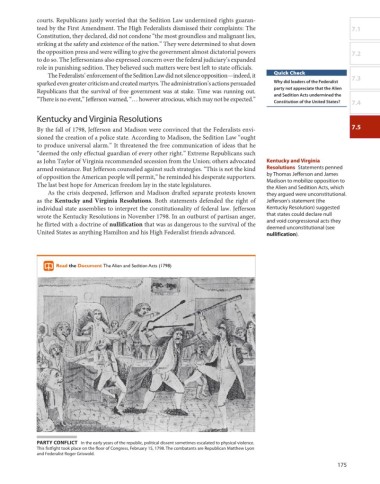
                    PArTy ConflICT   in the early years of the republic, political dissent sometimes escalated to physical violence.
                    This fistfight took place on the floor of congress, February 15, 1798. The combatants are Republican Matthew Lyon
                    and Federalist Roger Griswold.
                                                                                                                       175

