


Page 210 - American Stories, A History of the United States
P. 210
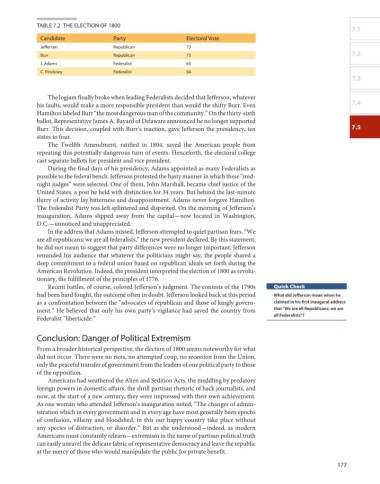
TAbLE 7.2  THE ELEcTiON OF 1800
                                                                                                                           7.1
                     candidate               Party                   Electoral Vote
                     Jefferson               Republican              73
                     burr                    Republican              73                                                    7.2
                     J. Adams                Federalist              65
                     c. Pinckney             Federalist              64
                                                                                                                           7.3

                       The logjam finally broke when leading Federalists decided that Jefferson,  whatever
                    his faults, would make a more responsible president than would the shifty Burr. Even                   7.4
                    Hamilton labeled Burr “the most dangerous man of the community.” On the thirty-sixth
                    ballot, Representative James A. Bayard of Delaware announced he no  longer  supported
                    Burr. This decision, coupled with Burr’s inaction, gave Jefferson the  presidency, ten                 7.5
                    states to four.
                       The Twelfth Amendment, ratified in 1804, saved the American people from
                    repeating this potentially dangerous turn of events. Henceforth, the electoral college
                    cast separate ballots for president and vice president.
                       During the final days of his presidency, Adams appointed as many Federalists as
                    possible to the federal bench. Jefferson protested the hasty manner in which these “mid-
                    night judges” were selected. One of them, John Marshall, became chief justice of the
                    United States, a post he held with distinction for 34 years. But behind the last-minute
                    flurry of activity lay bitterness and disappointment. Adams never forgave Hamilton.
                    The Federalist Party was left splintered and dispirited. On the morning of Jefferson’s
                    inauguration,  Adams  slipped  away  from  the  capital—now  located  in   Washington,
                    D.C.—unnoticed and unappreciated.
                       In the address that Adams missed, Jefferson attempted to quiet partisan fears. “We
                    are all republicans; we are all federalists,” the new president declared. By this statement,
                    he did not mean to suggest that party differences were no longer important. Jefferson
                    reminded his audience that whatever the politicians might say, the people shared a
                    deep commitment to a federal union based on republican ideals set forth during the
                    American Revolution. Indeed, the president interpreted the election of 1800 as revolu-
                    tionary, the fulfillment of the principles of 1776.
                       Recent battles, of course, colored Jefferson’s judgment. The contests of the 1790s   Quick Check
                    had been hard fought, the outcome often in doubt. Jefferson looked back at this period   What did Jefferson mean when he
                    as a confrontation between the “advocates of republican and those of kingly govern-  claimed in his first inaugural address
                    ment.” He believed that only his own party’s vigilance had saved the country from   that “We are all Republicans; we are
                    Federalist “liberticide.”                                                     all federalists”?


                    conclusion: Danger of Political Extremism
                    From a broader historical perspective, the election of 1800 seems noteworthy for what
                    did not occur. There were no riots, no attempted coup, no secession from the Union,
                    only the peaceful transfer of government from the leaders of one political party to those
                    of the opposition.
                       Americans had weathered the Alien and Sedition Acts, the meddling by predatory
                    foreign powers in domestic affairs, the shrill partisan rhetoric of hack journalists, and
                    now, at the start of a new century, they were impressed with their own achievement.
                    As one woman who attended Jefferson’s inauguration noted, “The changes of admin-
                    istration which in every government and in every age have most generally been epochs
                    of confusion, villainy and bloodshed, in this our happy country take place without
                    any species of distraction, or disorder.” But as she understood—indeed, as modern
                      Americans must constantly relearn—extremism in the name of partisan political truth
                    can easily unravel the delicate fabric of representative democracy and leave the republic
                    at the mercy of those who would manipulate the public for private benefit.

                                                                                                                       177

