


Page 206 - American Stories, A History of the United States
P. 206
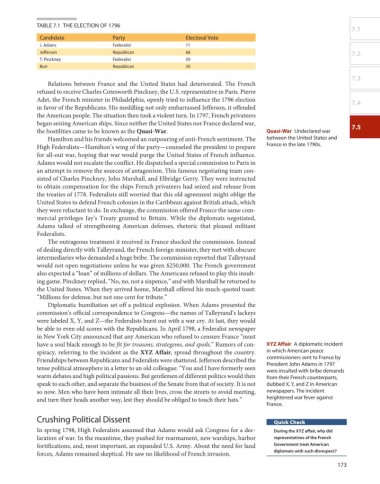
TAbLE 7.1  THE ELEcTiON OF 1796
                                                                                                                           7.1
                     candidate               Party                   Electoral Vote
                     J. Adams                Federalist              71
                     Jefferson               Republican              68                                                    7.2
                     T. Pinckney             Federalist              59
                     burr                    Republican              30

                                                                                                                           7.3
                       Relations between France and the United States had deteriorated. The French
                    refused to receive Charles Cotesworth Pinckney, the U.S. representative in Paris. Pierre
                    Adet, the French minister in Philadelphia, openly tried to influence the 1796 election                 7.4
                    in favor of the Republicans. His meddling not only embarrassed Jefferson, it offended
                    the American people. The situation then took a violent turn. In 1797, French privateers
                    began seizing American ships. Since neither the United States nor France declared war,
                    the hostilities came to be known as the Quasi-War.                         quasi-War  Undeclared war   7.5
                       Hamilton and his friends welcomed an outpouring of anti-French sentiment. The   between the United States and
                    High Federalists—Hamilton’s wing of the party—counseled the president to prepare   France in the late 1790s.
                    for all-out war, hoping that war would purge the United States of French influence.
                    Adams would not escalate the conflict. He dispatched a special commission to Paris in
                    an attempt to remove the sources of antagonism. This famous negotiating team con-
                    sisted of Charles Pinckney, John Marshall, and Elbridge Gerry. They were instructed
                    to obtain compensation for the ships French privateers had seized and release from
                    the treaties of 1778. Federalists still worried that this old agreement might oblige the
                    United States to defend French colonies in the Caribbean against British attack, which
                    they were reluctant to do. In exchange, the commission offered France the same com-
                    mercial privileges Jay’s Treaty granted to Britain. While the diplomats negotiated,
                    Adams talked of strengthening American  defenses, rhetoric that pleased militant
                    Federalists.
                       The outrageous treatment it received in France shocked the commission. Instead
                    of dealing directly with Talleyrand, the French foreign minister, they met with obscure
                    intermediaries who demanded a huge bribe. The commission reported that Talleyrand
                    would not open negotiations unless he was given $250,000. The French government
                    also expected a “loan” of millions of dollars. The Americans refused to play this insult-
                    ing game. Pinckney replied, “No, no, not a sixpence,” and with Marshall he returned to
                    the United States. When they arrived home, Marshall offered his much-quoted toast:
                    “Millions for defense, but not one cent for tribute.”
                       Diplomatic humiliation set off a political explosion. When Adams presented the
                    commission’s official correspondence to Congress—the names of Talleyrand’s lackeys
                    were labeled X, Y, and Z—the Federalists burst out with a war cry. At last, they would
                    be able to even old scores with the Republicans. In April 1798, a Federalist newspaper
                    in New York City announced that any American who refused to censure France “must
                    have a soul black enough to be fit for treasons, strategems, and spoils.” Rumors of con-  xyZ Affair  A diplomatic incident
                    spiracy, referring to the incident as the XYZ Affair, spread throughout the country.   in which American peace
                    Friendships between Republicans and Federalists were shattered. Jefferson described the   commissioners sent to France by
                    tense political atmosphere in a letter to an old colleague: “You and I have formerly seen   President John Adams in 1797
                                                                                               were insulted with bribe demands
                    warm debates and high political passions. But gentlemen of different politics would then   from their French counterparts,
                    speak to each other, and separate the business of the Senate from that of society. It is not   dubbed X, Y, and Z in American
                    so now. Men who have been intimate all their lives, cross the streets to avoid meeting,   newspapers. The incident
                    and turn their heads another way, lest they should be obliged to touch their hats.”  heightened war fever against
                                                                                               France.
                    crushing Political Dissent                                                    Quick Check

                    In spring 1798, High Federalists assumed that Adams would ask Congress for a dec-  During the XyZ affair, why did
                    laration of war. In the meantime, they pushed for rearmament, new warships, harbor     representatives of the french
                    fortifications, and, most important, an expanded U.S. Army. About the need for land     Government treat American
                    forces, Adams remained skeptical. He saw no likelihood of French invasion.      diplomats with such disrespect?
                                                                                                                       173

