


Page 409 - American Stories, A History of the United States
P. 409
On MyHistoryLab                                                           Study and Review on MyHistoryLab


                    Chapter Review                                       timeline


                  the President versus Congress
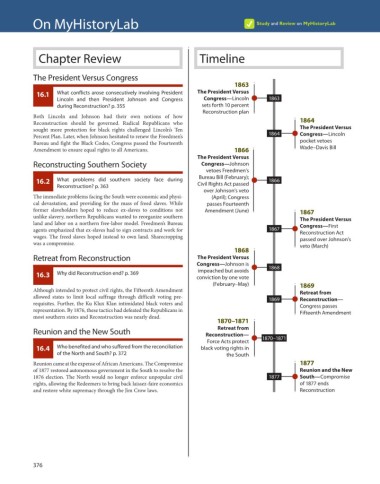
                                                                                     1863
                     16.1    What conflicts arose consecutively involving President   the President Versus
                          Lincoln  and  then  President  Johnson  and  Congress   Congress—Lincoln   1863
                          during Reconstruction? p. 355                   sets forth 10 percent
                                                                          Reconstruction plan
                  Both Lincoln and Johnson had their own notions of how
                  Reconstruction  should  be  governed.  Radical  Republicans  who                        1864
                  sought more protection for black rights challenged Lincoln’s Ten                        the President Versus
                  Percent Plan. Later, when Johnson hesitated to renew the Freedmen’s           1864      Congress—Lincoln
                  Bureau and fight the Black Codes, Congress passed the Fourteenth                        pocket vetoes
                  Amendment to ensure equal rights to all Americans.                 1866                 Wade–Davis Bill
                                                                        the President Versus
                  Reconstructing Southern Society                         Congress—Johnson
                                                                           vetoes Freedmen’s
                     16.2    What problems did southern society face during   Bureau Bill (February);  1866
                          Reconstruction? p. 363                        Civil Rights Act passed
                                                                           over Johnson’s veto
                  The immediate problems facing the South were economic and physi-  (April); Congress
                  cal devastation, and providing for the mass of freed slaves. While   passes Fourteenth
                  former slaveholders hoped to reduce ex-slaves to conditions not   Amendment (June)      1867
                  unlike slavery, northern Republicans wanted to reorganize southern                      the President Versus
                  land and labor on a northern free-labor model. Freedmen’s Bureau                        Congress—First
                  agents emphasized that ex-slaves had to sign contracts and work for           1867      Reconstruction Act
                  wages. The freed slaves hoped instead to own land. Sharecropping                        passed over Johnson’s
                  was a compromise.                                                                       veto (March)
                                                                                     1868
                  Retreat from Reconstruction                           the President Versus
                                                                        Congress—Johnson is     1868
                                                                         impeached but avoids
                    16.3    Why did Reconstruction end? p. 369          conviction by one vote
                                                                              (February–May)              1869
                  Although intended to protect civil rights, the Fifteenth Amendment                      Retreat from
                  allowed states to limit local suffrage through difficult voting pre-          1869      Reconstruction—
                  requisites. Further, the Ku Klux Klan intimidated black voters and                      Congress passes
                  representation. By 1876, these tactics had defeated the Republicans in                  Fifteenth Amendment
                  most southern states and Reconstruction was nearly dead.
                                                                               1870–1871
                                                                               Retreat from
                  Reunion and the New South                                Reconstruction—
                                                                            Force Acts protect   1870–1871
                    16.4    Who benefited and who suffered from the reconciliation   black voting rights in
                          of the North and South? p. 372                          the South
                  Reunion came at the expense of African Americans. The Compromise                        1877
                  of 1877 restored autonomous government in the South to resolve the                      Reunion and the new
                  1876 election. The North would no longer enforce unpopular civil              1877      South—Compromise
                  rights, allowing the Redeemers to bring back laissez-faire economics                    of 1877 ends
                  and restore white supremacy through the Jim Crow laws.                                  Reconstruction


                  376

