


Page 406 - American Stories, A History of the United States
P. 406
determine who would receive the votes of the dis-
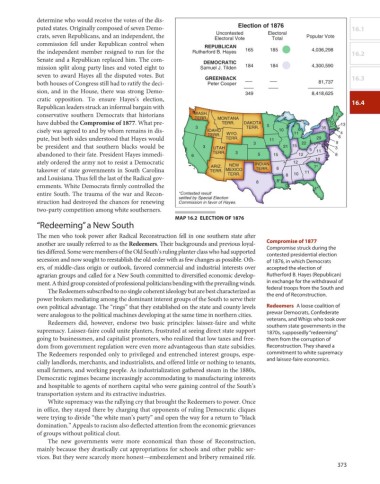
                    puted states. Originally composed of seven Demo-                  Election of 1876                     16.1
                                                                               Uncontested
                    crats, seven Republicans, and an independent, the         Electoral Vote    Electoral   Popular Vote
                                                                                                 Total
                    commission fell under Republican control when          REPUBLICAN
                    the independent member resigned to run for the     Rutherford B. Hayes  165  185          4,036,298    16.2
                    Senate and a Republican replaced him. The com-        DEMOCRATIC
                    mission split along party lines and voted eight to   Samuel J. Tilden  184  184           4,300,590
                    seven to award Hayes all the disputed votes. But       GREENBACK                                       16.3
                    both houses of Congress still had to ratify the deci-   Peter Cooper                        81,737
                    sion, and in the House, there was strong Demo-                      349                   8,418,625
                    cratic opposition. To ensure Hayes’s election,                                                         16.4
                    Republican leaders struck an informal bargain with
                    conservative  southern  Democrats  that  historians   WASH.  MONTANA                              7
                                                                        TERR.
                    have dubbed the Compromise of 1877. What pre-               TERR.   DAKOTA  5                  5  5  13
                    cisely was agreed to and by whom remains in dis-    3   IDAHO  WYO.  TERR.     10   11       35    4
                    pute, but both sides understood that Hayes would        TERR.  TERR.        11              29     6
                    be president and that southern blacks would be        3   UTAH         3         21 15  22  5     3 9
                    abandoned to their fate. President Hayes immedi-  6      TERR.   3      5    15       12    11    8
                    ately ordered the army not to resist a Democratic              NEW     INDIAN       12     10
                                                                             ARIZ.
                    takeover of state governments in South Carolina          TERR.  MEXICO  TERR.  6        11  7*
                    and Louisiana. Thus fell the last of the Radical gov-         TERR.           8*  8  10
                    ernments. White Democrats firmly controlled the                         8                  4*
                    entire South. The trauma of the war and Recon-  *Contested result
                    struction had destroyed the chances for renewing   settled by Special Election
                                                                  Commission in favor of Hayes.
                    two-party competition among white southerners.
                                                                 maP 16.2  eleCtIon oF 1876
                    “Redeeming” a New South

                    The men who took power after Radical Reconstruction fell in one southern state after
                    another are usually referred to as the Redeemers. Their backgrounds and previous loyal-  Compromise of 1877
                                                                                               Compromise struck during the
                    ties differed. Some were members of the Old South’s ruling planter class who had supported   contested presidential election
                    secession and now sought to reestablish the old order with as few changes as possible. Oth-  of 1876, in which Democrats
                    ers, of middle-class origin or outlook, favored commercial and industrial interests over   accepted the election of
                    agrarian groups and called for a New South committed to diversified economic develop-  Rutherford B. Hayes (Republican)
                    ment. A third group consisted of professional politicians bending with the prevailing winds.  in exchange for the withdrawal of
                       The Redeemers subscribed to no single coherent ideology but are best characterized as   federal troops from the South and
                                                                                               the end of Reconstruction.
                    power brokers mediating among the dominant interest groups of the South to serve their
                    own political advantage. The “rings” that they established on the state and county levels   Redeemers  A loose coalition of
                    were analogous to the political machines developing at the same time in northern cities.  prewar Democrats, Confederate
                       Redeemers did, however, endorse two basic principles: laissez-faire and white   veterans, and Whigs who took over
                                                                                               southern state governments in the
                    supremacy. Laissez-faire could unite planters, frustrated at seeing direct state support   1870s, supposedly “redeeming”
                    going to businessmen, and capitalist promoters, who realized that low taxes and free-  them from the corruption of
                    dom from government regulation were even more advantageous than state subsidies.   Reconstruction. they shared a
                    The Redeemers responded only to privileged and entrenched interest groups, espe-  commitment to white supremacy
                    cially landlords, merchants, and industrialists, and offered little or nothing to tenants,   and laissez-faire economics.
                    small farmers, and working people. As industrialization gathered steam in the 1880s,
                    Democratic regimes became increasingly accommodating to manufacturing interests
                    and hospitable to agents of northern capital who were gaining control of the South’s
                    transportation system and its extractive industries.
                       White supremacy was the rallying cry that brought the Redeemers to power. Once
                    in office, they stayed there by charging that opponents of ruling Democratic cliques
                    were trying to divide “the white man’s party” and open the way for a return to “black
                    domination.” Appeals to racism also deflected attention from the economic grievances
                    of groups without political clout.
                       The new governments were more economical than those of Reconstruction,
                    mainly because they drastically cut appropriations for schools and other public ser-
                    vices. But they were scarcely more honest—embezzlement and bribery remained rife.
                                                                                                                       373

