


Page 401 - American Stories, A History of the United States
P. 401
Blacks served or supported corrupt and wasteful regimes because the alternative
            16.1                                was dire. Although the Democrats, or Conservatives as they called themselves in some
                                                states, made sporadic efforts to attract African American voters, it was clear that if they
                                                won control, they would strip blacks of their civil and political rights. But opponents of
            16.2                                Radical Reconstruction capitalized on racial prejudice and persuaded many Americans
                                                that “good government” was synonymous with white supremacy.
                                                    Contrary to myth, the few African Americans elected to state or national office

            16.3                                during Reconstruction demonstrated on the average more integrity and competence
                                                than their white counterparts. Most were fairly well educated, having been free or
                                                unusually privileged slaves before the war. Among the most capable were Robert Smalls
                                                (whose career was described earlier); Blanche K. Bruce of Mississippi, elected to the
            16.4
                                                U.S. Senate in 1874 after rising to prominence in the Republican party of his home
                     Quick Check                state; Congressman Robert Brown Elliott of South Carolina, an adroit politician who
                     What were the three social groups   was also a consistent champion of civil rights; and Congressman James T. Rapier of
                     that made up the southern   Alabama, who stirred the nation in 1873 with his appeals for federal aid to southern
                       Republican party?        education and new laws to enforce equal rights for African Americans.

                                                Claiming Public and Private Rights

                                                The ways that freed slaves claimed rights for themselves were as important as party
                                                politics to the changing political culture of the Reconstruction South. Ex-slaves fought
                                                for their rights not only in negotiations with employers and in public meetings and
                                                convention halls, but also through the institutions they created and, perhaps most
                                                important, the households they formed.
                                                    Some ex-slaves used institutions formerly closed to them, like the courts, to assert
                                                rights they considered part of citizenship. Many ex-slaves rushed to formalize their


                                                      Watch the Video  The Schools that the Civil War and Reconstruction Created


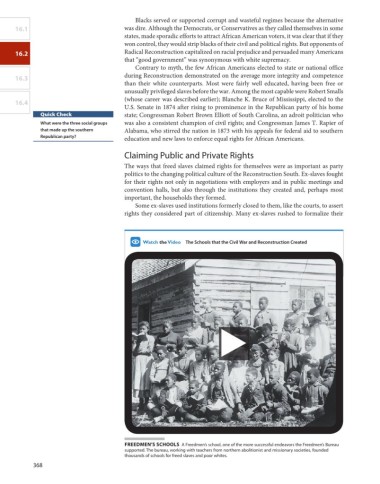
                                                FReeDmen’S SCHoolS  A Freedmen’s school, one of the more successful endeavors the Freedmen’s Bureau
                                                supported. the bureau, working with teachers from northern abolitionist and missionary societies, founded
                                                thousands of schools for freed slaves and poor whites.
                  368

