


Page 398 - American Stories, A History of the United States
P. 398
hoping to find something better. Some were still expecting land, but others were simply
                    trying to increase their bargaining power. One freedman recalled that an important                     16.1
                    part of being free was that “we could move around [and] change bosses.” By the end of
                    1865, many freedmen had still not signed up for the coming season; anxious planters
                    feared that blacks were plotting to seize land by force. Within weeks, however, most                   16.2
                    holdouts signed for the best terms they could get.
                       One common form of agricultural employment in 1866 was a contract labor sys-  sharecropping  After the Civil
                    tem. Under this system, workers committed themselves for a year in return for fixed   War, the southern states adopted   16.3
                    wages, much of which was withheld until after the harvest. Since many planters drove   a sharecropping system as a
                    hard bargains, abused their workers, or cheated them at the end of the year, the Freed-  compromise between former
                    men’s Bureau reviewed and enforced the contracts. But bureau officials had differing   slaves who wanted land of their   16.4
                    notions of what it meant to protect African Americans from exploitation. Some stood   own and former slave owners who
                    up for the rights of the freedmen; others served as allies of the planters.  needed labor. the landowners
                                                                                               provided land, tools, and seed
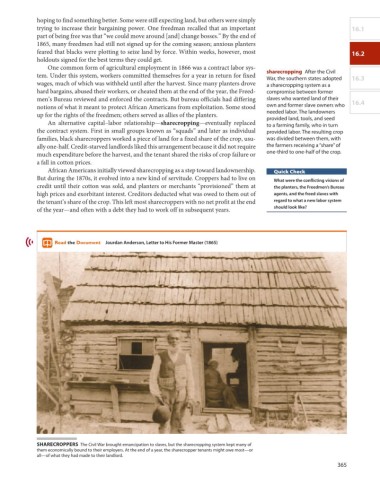
                       An alternative capital–labor relationship—sharecropping—eventually replaced   to a farming family, who in turn
                    the contract system. First in small groups known as “squads” and later as individual   provided labor. the resulting crop
                    families, black sharecroppers worked a piece of land for a fixed share of the crop, usu-  was divided between them, with
                    ally one-half. Credit-starved landlords liked this arrangement because it did not require   the farmers receiving a “share” of
                    much expenditure before the harvest, and the tenant shared the risks of crop failure or   one-third to one-half of the crop.
                    a fall in cotton prices.
                       African Americans initially viewed sharecropping as a step toward landownership.   Quick Check
                    But during the 1870s, it evolved into a new kind of servitude. Croppers had to live on   What were the conflicting visions of
                    credit until their cotton was sold, and planters or merchants “provisioned” them at   the planters, the Freedmen’s Bureau
                    high prices and exorbitant interest. Creditors deducted what was owed to them out of   agents, and the freed slaves with
                    the tenant’s share of the crop. This left most sharecroppers with no net profit at the end   regard to what a new labor system
                    of the year—and often with a debt they had to work off in subsequent years.   should look like?


                           Read the Document  Jourdan Anderson, Letter to his Former Master (1865)


                    SHaReCRoPPeRS  the Civil War brought emancipation to slaves, but the sharecropping system kept many of
                    them economically bound to their employers. At the end of a year, the sharecropper tenants might owe most—or
                    all—of what they had made to their landlord.
                                                                                                                       365

