


Page 403 - American Stories, A History of the United States
P. 403
16.1                                      Watch the Video  The Promise and Failure of Reconstruction


            16.2


            16.3


            16.4


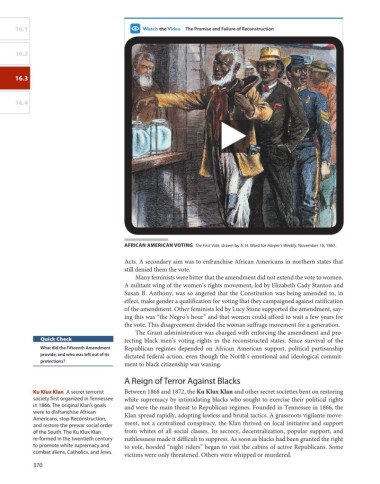
                                                aFRICan ameRICan VotInG  The First Vote, drawn by A. H. Ward for Harper’s Weekly, November 16, 1867.

                                                Acts. A secondary aim was to enfranchise African Americans in northern states that
                                                still denied them the vote.
                                                    Many feminists were bitter that the amendment did not extend the vote to women.
                                                A militant wing of the women’s rights movement, led by Elizabeth Cady Stanton and
                                                Susan B. Anthony, was so angered that the Constitution was being amended to, in
                                                effect, make gender a qualification for voting that they campaigned against ratification
                                                of the amendment. Other feminists led by Lucy Stone supported the amendment, say-
                                                ing this was “the Negro’s hour” and that women could afford to wait a few years for
                                                the vote. This disagreement divided the woman suffrage movement for a generation.
                                                    The Grant administration was charged with enforcing the amendment and pro-
                     Quick Check                tecting black men’s voting rights in the reconstructed states. Since survival of the
                     What did the Fifteenth Amendment   Republican regimes depended on African American support, political partisanship
                     provide, and who was left out of its   dictated federal action, even though the North’s emotional and ideological commit-
                     protections?
                                                ment to black citizenship was waning.

                                                A Reign of terror Against Blacks
                  Ku Klux Klan  A secret terrorist   Between 1868 and 1872, the Ku Klux Klan and other secret societies bent on restoring
                  society first organized in tennessee   white supremacy by intimidating blacks who sought to exercise their political rights
                  in 1866. the original Klan’s goals   and were the main threat to Republican regimes. Founded in Tennessee in 1866, the
                  were to disfranchise African
                  Americans, stop Reconstruction,   Klan spread rapidly, adopting lawless and brutal tactics. A grassroots vigilante move-
                  and restore the prewar social order   ment, not a centralized conspiracy, the Klan thrived on local initiative and support
                  of the South. the Ku Klux Klan   from whites of all social classes. Its secrecy, decentralization, popular support, and
                  re-formed in the twentieth century   ruthlessness made it difficult to suppress. As soon as blacks had been granted the right
                  to promote white supremacy and   to vote, hooded “night riders” began to visit the cabins of active Republicans. Some
                  combat aliens, Catholics, and Jews.  victims were only threatened. Others were whipped or murdered.

                  370

