


Page 408 - American Stories, A History of the United States
P. 408
16.1


                                                                                                                           16.2


                                                                                                                           16.3


                                                                                                                           16.4


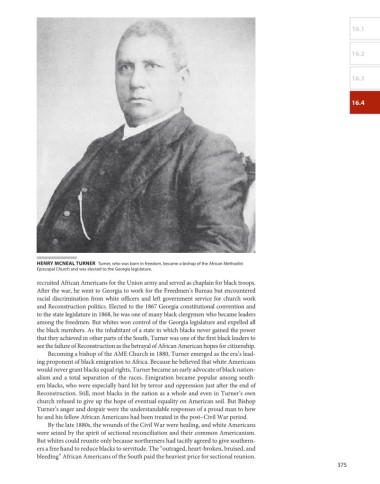
                    HenRy mCneal tURneR  turner, who was born in freedom, became a bishop of the African Methodist
                    episcopal Church and was elected to the Georgia legislature.

                    recruited African Americans for the Union army and served as chaplain for black troops.
                    After the war, he went to Georgia to work for the Freedmen’s Bureau but encountered
                    racial discrimination from white officers and left government service for church work
                    and Reconstruction politics. Elected to the 1867 Georgia constitutional convention and
                    to the state legislature in 1868, he was one of many black clergymen who became leaders
                    among the freedmen. But whites won control of the Georgia legislature and expelled all
                    the black members. As the inhabitant of a state in which blacks never gained the power
                    that they achieved in other parts of the South, Turner was one of the first black leaders to
                    see the failure of Reconstruction as the betrayal of African American hopes for citizenship.
                       Becoming a bishop of the AME Church in 1880, Turner emerged as the era’s lead-
                    ing proponent of black emigration to Africa. Because he believed that white Americans
                    would never grant blacks equal rights, Turner became an early advocate of black nation-
                    alism and a total separation of the races. Emigration became popular among south-
                    ern blacks, who were especially hard hit by terror and oppression just after the end of
                      Reconstruction. Still, most blacks in the nation as a whole and even in Turner’s own
                    church refused to give up the hope of eventual equality on American soil. But Bishop
                    Turner’s anger and despair were the understandable responses of a proud man to how
                    he and his fellow African Americans had been treated in the post–Civil War period.
                       By the late 1880s, the wounds of the Civil War were healing, and white Americans
                    were seized by the spirit of sectional reconciliation and their common Americanism.
                    But whites could reunite only because northerners had tacitly agreed to give southern-
                    ers a free hand to reduce blacks to servitude. The “outraged, heart-broken, bruised, and
                    bleeding” African Americans of the South paid the heaviest price for sectional reunion.
                                                                                                                       375

