


Page 393 - American Stories, A History of the United States
P. 393
The disagreement between the president and Congress became irreconcilable in
            16.1                                early 1866, when Johnson vetoed two bills that had passed with overwhelming Repub-
                  Freedmen’s bureau  Agency     lican support. The first extended the life of the Freedmen’s Bureau—a temporary
                  established by Congress in March   agency set up to provide relief, education, legal help, and assistance in obtaining land
                  1865 to provide freedmen with
            16.2   shelter, food, and medical aid and   or work to former slaves. The second was a civil rights bill to nullify the Black Codes
                  to help them establish schools and   and guarantee to freedmen “full and equal benefit of all laws and proceedings for the
                  find employment. the Bureau was   security of person and property as is enjoyed by white citizens.”
            16.3   dissolved in 1872.               Johnson’s vetoes shocked moderate Republicans. He succeeded in blocking the
                                                Freedmen’s Bureau bill, although a modified version later passed. But his veto of the
                                                Civil Rights Act was overridden, signifying that the president was now hopelessly
                                                at odds with most of the legislators from what was supposed to be his own party.
            16.4
                                                  Congress had not overridden a presidential veto since Franklin Pierce was president
                                                in the early 1850s.
                                                    Johnson soon revealed that he intended to place himself at the head of a new con-
                                                servative party uniting the few Republicans who supported him with a reviving Demo-
                                                cratic party that was rallying behind his Reconstruction policy. In preparation for the
                                                elections of 1866, Johnson helped found the National Union movement to promote
                                                his plan to readmit the southern states to the Union without further qualifications. A
                                                National Union convention in Philadelphia called for electing men to Congress who
                                                endorsed the presidential plan for Reconstruction.
                                                    Meanwhile, the Republican majority on Capitol Hill, fearing that Johnson would
                                                not enforce civil rights legislation or that the courts would declare such laws unconsti-
                  Fourteenth amendment  Ratified   tutional, passed the Fourteenth Amendment. This, perhaps the most important of all
                  in 1868, it provided citizenship   the constitutional amendments, gave the federal government responsibility for guaran-
                  to ex-slaves after the Civil War   teeing equal rights under the law to all Americans. Section 1 defined national citizen-
                  and constitutionally protected
                  equal rights under the law for   ship for the first time as extending to “all persons born or naturalized in the United
                  all citizens. Radical Republicans   States.” The states were prohibited from abridging the rights of American citizens and
                  used it to enact a congressional   could not “deprive any person of life, liberty, or property, without due process of law;
                  Reconstruction policy in the former   nor deny to any person … equal protection of the laws.” The amendment was sent
                  Confederate states.           to the states with the understanding that southerners would have no chance of being
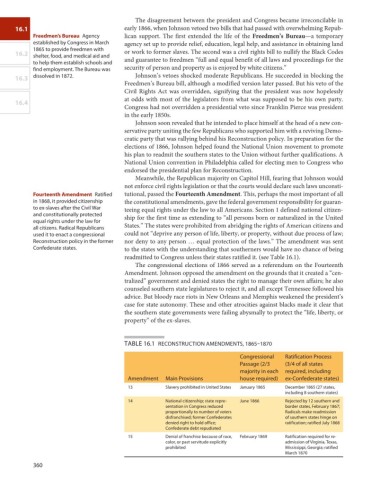
                                                readmitted to Congress unless their states ratified it. (see Table 16.1).
                                                    The congressional elections of 1866 served as a referendum on the Fourteenth
                                                Amendment. Johnson opposed the amendment on the grounds that it created a “cen-
                                                tralized” government and denied states the right to manage their own affairs; he also
                                                counseled southern state legislatures to reject it, and all except Tennessee followed his
                                                advice. But bloody race riots in New Orleans and Memphis weakened the president’s
                                                case for state autonomy. These and other atrocities against blacks made it clear that
                                                the southern state governments were failing abysmally to protect the “life, liberty, or
                                                property” of the ex-slaves.


                                                tABLe 16.1  ReCONStRUCtiON AMeNDMeNtS, 1865–1870

                                                                                      Congressional   Ratification Process
                                                                                      Passage (2/3    (3/4 of all states
                                                                                      majority in each  required, including
                                                  Amendment   Main Provisions         house required)  ex-Confederate states)
                                                  13          Slavery prohibited in United States  January 1865  December 1865 (27 states,
                                                                                                     including 8 southern states)
                                                  14          National citizenship; state repre-  June 1866  Rejected by 12 southern and
                                                              sentation in Congress reduced          border states, February 1867;
                                                              proportionally to number of voters     Radicals make readmission
                                                              disfranchised; former Confederates     of southern states hinge on
                                                              denied right to hold office;           ratification; ratified July 1868
                                                              Confederate debt repudiated
                                                  15          Denial of franchise because of race,   February 1869  Ratification required for re-
                                                              color, or past servitude explicitly    admission of virginia, texas,
                                                              prohibited                             Mississippi, Georgia; ratified
                                                                                                     March 1870
                  360

