


Page 392 - American Stories, A History of the United States
P. 392
Read the Document  The Mississippi Black Code (1865)                                            16.1


                                                                                                                           16.2


                                                                                                                           16.3


                                                                                                                           16.4


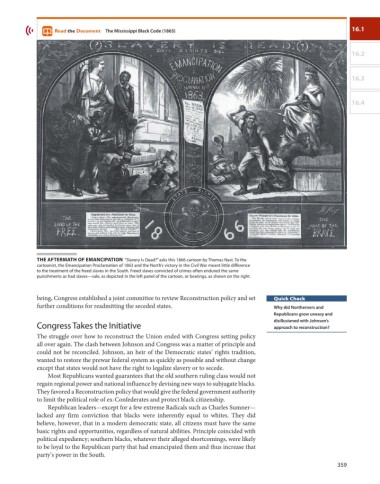
                    tHe aFteRmatH oF emanCIPatIon  “Slavery is Dead?” asks this 1866 cartoon by thomas Nast. to the
                    cartoonist, the emancipation Proclamation of 1863 and the North’s victory in the Civil War meant little difference
                    to the treatment of the freed slaves in the South. Freed slaves convicted of crimes often endured the same
                    punishments as had slaves—sale, as depicted in the left panel of the cartoon, or beatings, as shown on the right.


                    being, Congress established a joint committee to review Reconstruction policy and set   Quick Check
                    further conditions for readmitting the seceded states.                        Why did Northerners and
                                                                                                    Republicans grow uneasy and
                                                                                                    disillusioned with Johnson’s
                    Congress takes the initiative                                                   approach to reconstruction?
                    The struggle over how to reconstruct the Union ended with Congress setting policy
                    all over again. The clash between Johnson and Congress was a matter of principle and
                    could not be reconciled. Johnson, an heir of the Democratic states’ rights tradition,
                    wanted to restore the prewar federal system as quickly as possible and without change
                    except that states would not have the right to legalize slavery or to secede.
                       Most Republicans wanted guarantees that the old southern ruling class would not
                    regain regional power and national influence by devising new ways to subjugate blacks.
                    They favored a Reconstruction policy that would give the federal government authority
                    to limit the political role of ex-Confederates and protect black citizenship.
                       Republican leaders—except for a few extreme Radicals such as Charles  Sumner—
                    lacked any firm conviction that blacks were inherently equal to whites. They did
                    believe, however, that in a modern democratic state, all citizens must have the same
                    basic rights and opportunities, regardless of natural abilities. Principle coincided with
                    political expediency; southern blacks, whatever their alleged shortcomings, were likely
                    to be loyal to the Republican party that had emancipated them and thus increase that
                    party’s power in the South.
                                                                                                                       359

