


Page 394 - American Stories, A History of the United States
P. 394
Johnson further hurt his cause by taking the stump on behalf of candidates who
                    supported his policies. In his notorious “swing around the circle,” he toured the nation,              16.1
                    slandering his opponents in crude language and engaging in undignified exchanges
                    with hecklers. Enraged by southern inflexibility and the antics of a president who acted
                    as if he were still campaigning in the backwoods of Tennessee, northern voters repudi-  Quick Check    16.2
                    ated the administration. The Republican majority in Congress increased to a solid two-  What events caused Congress to
                    thirds in both houses, and the Radical wing of the party gained strength at the expense   take the initiative in passing the
                    of moderates and conservatives.                                               Fourteenth Amendment?    16.3


                    Congressional Reconstruction Plan enacted
                    Congress now implemented its own plan of Reconstruction. In 1867 and 1868, it nul-                     16.4
                    lified the president’s initiatives and reorganized the South. Generally referred to as
                    Radical Reconstruction, the measures actually represented a compromise between   Radical Reconstruction the
                    genuine Radicals and more moderate Republicans.                            Reconstruction Acts of 1867
                       Radicals  such  as  Senator  Charles  Sumner  of  Massachusetts  and  Congressmen   divided the South into five military
                      Thaddeus Stevens of Pennsylvania and George Julian of Indiana wanted to reshape   districts. they required the states
                                                                                               to guarantee black male suffrage
                    southern society before readmitting ex-Confederates to the Union. Their program of   and to ratify the Fourteenth
                    “regeneration before Reconstruction” required an extended period of military rule, con-  Amendment as a condition of their
                    fiscation and redistribution of large landholdings among the freedmen, and federal aid   readmission to the Union.
                    for schools to educate blacks and whites for citizenship. But most Republican congress-
                    men found such a program unacceptable because it broke too sharply with  American
                    traditions of federalism and regard for property rights, and might take decades.
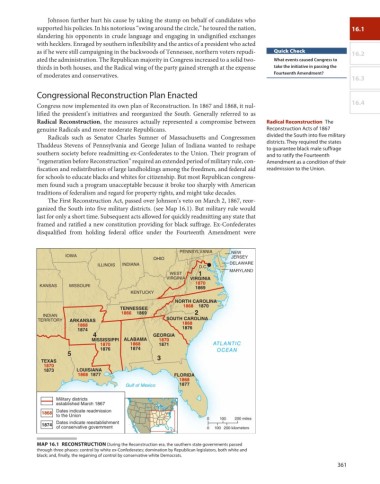
                       The First Reconstruction Act, passed over Johnson’s veto on March 2, 1867, reor-
                    ganized the South into five military districts. (see Map 16.1). But military rule would
                    last for only a short time. Subsequent acts allowed for quickly readmitting any state that
                    framed and ratified a new constitution providing for black suffrage. Ex- Confederates
                    disqualified from holding federal office under the Fourteenth Amendment were


                                                                   PENNSYLVANIA     NEW
                                                                   PENNSYLVANIA
                             IOWA
                             IOWA
                                                          OHIO
                                                          OHIO                      JERSEY
                                                INDIANA
                                        ILLINOIS  INDIANA                D.C.      DELAWARE
                                        ILLINOIS
                                                                         D.C.
                                                               WEST      1 1       MARYLAND
                                                               WEST
                                                              VIRGINIA
                                                              VIRGINIA  VIRGINIA
                                                                      VIRGINIA
                                                                        1870
                              MISSOURI
                     KANSAS
                     KANSAS   MISSOURI                                  1870
                                                                        1869
                                                                        1869
                                                  KENTUCKY
                                                  KENTUCKY
                                                                 NORTH CAROLINA
                                                                 NORTH CAROLINA
                                                                    1868    1870
                                               TENNESSEE
                                               TENNESSEE            1868    1870
                                               1866    1869
                      INDIAN
                      INDIAN                   1866    1869             2 2
                                                              SOUTH CAROLINA
                    TERRITORY
                    TERRITORY  ARKANSAS                       SOUTH CAROLINA
                              ARKANSAS
                                                                   1868
                                 1868
                                 1868                              1868
                                                                   1876
                                 1874
                                 1874                              1876
                                      4 4                 GEORGIA
                                                          GEORGIA
                                                ALABAMA
                                                            1870
                                      MISSISSIPPI
                                      MISSISSIPPI  ALABAMA  1870
                                                  1868
                                        1870
                                        1870      1868      1871              ATLANTIC
                                                            1871
                                                  1874
                                        1876
                                        1876      1874                         OCEAN
                              5 5
                     TEXAS
                     TEXAS                                 3 3
                      1870
                      1870
                                 LOUISIANA
                      1873       LOUISIANA
                      1873
                                 1868  1877
                                 1868  1877                      FLORIDA
                                                                 FLORIDA
                                                                  1868
                                                                  1868
                                                                  1877
                                                 Gulf of Mexico   1877
                          Military districts
                          established March 1867
                     1868  Dates indicate readmission
                          to the Union
                                                                            0   100  200 miles
                          Dates indicate reestablishment
                     1874
                          of conservative government                        0  100 200 kilometers
                    maP 16.1  ReConStRUCtIon During the Reconstruction era, the southern state governments passed
                    through three phases: control by white ex-Confederates; domination by Republican legislators, both white and
                    black; and, finally, the regaining of control by conservative white Democrats.
                                                                                                                       361

