


Page 390 - American Stories, A History of the United States
P. 390
Explore                                                                                          16.1


                          Reconstruction on

                          MyHistoryLab                                                                                     16.2


                     HoW DID                                                                                               16.3
                     ReConStRUCtIon
                     aFFeCt aFRICan                                                                                        16.4
                     ameRICanS In tHe
                     SoUtH?


                     In 1865, at the end of the Civil War,
                     the United States was at a crossroads.
                     The Thirteenth Amendment to the
                     Constitution had freed the slaves
                     of the rebellious eleven states, but
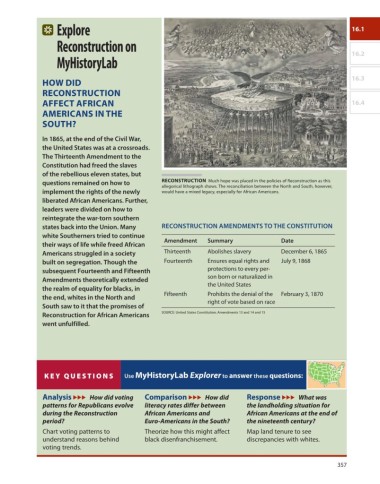
                                                             ReConStRUCtIon  Much hope was placed in the policies of Reconstruction as this
                     questions remained on how to            allegorical lithograph shows. the reconciliation between the North and South, however,
                     implement the rights of the newly       would have a mixed legacy, especially for African Americans.
                     liberated African Americans. Further,
                     leaders were divided on how to
                     reintegrate the war-torn southern
                     states back into the Union. Many        ReCoNSTRUCTIoN AMeNdMeNTS To The CoNSTITUTIoN
                     white Southerners tried to continue     Amendment      Summary                 date
                     their ways of life while freed African
                     Americans struggled in a society        thirteenth     Abolishes slavery       December 6, 1865
                     built on segregation. Though the        Fourteenth     ensures equal rights and   July 9, 1868
                     subsequent Fourteenth and Fifteenth                    protections to every per-
                     Amendments theoretically extended                      son born or naturalized in
                     the realm of equality for blacks, in                   the United States
                     the end, whites in the North and        Fifteenth      Prohibits the denial of the   February 3, 1870
                                                                            right of vote based on race
                     South saw to it that the promises of
                     Reconstruction for African Americans    SOURCe: United States Constitution; Amendments 13 and 14 and 15
                     went unfulfilled.


                      K e y  Q u e S T io n S   Use myHistorylab Explorer to answer these questions:


                     analysis         How did voting   Comparison           How did      Response         What was
                     patterns for Republicans evolve   literacy rates differ between     the landholding situation for
                     during the Reconstruction         African Americans and             African Americans at the end of
                     period?                           Euro-Americans in the South?      the nineteenth century?
                     Chart voting patterns to          theorize how this might affect    Map land tenure to see
                     understand reasons behind         black disenfranchisement.         discrepancies with whites.
                     voting trends.


                                                                                                                       357

