


Page 529 - Business Principles and Management
P. 529
Unit 6


                                                Producing the Product


                                                If the new product has survived the research and design process, the company
                                                can begin producing for sale. This is an expensive step. The company may have
                                                to build or remodel its manufacturing facilities. It must purchase raw materials
                                                and hire and train enough employees to produce the product. Then it must pro-
                                                mote, distribute, and sell the product. However, if the company has carefully
                                                planned and produced the product, the product has a better chance of succeed-
                                                ing and earning a profit for the company when customers purchase it.
                                                   As you learned in Chapter 1, production is making a product or providing a
                                                service. Manufacturing is a form of production in which raw and semifinished
                                                materials are processed, assembled, or converted into finished products.
                                                   Manufacturing is a complex process, even when only one product is pro-
                                                duced. Examine any product you purchased recently. Very likely, it is made of
                                                several parts. The company must either manufacture those parts or purchase
                                                them from other companies. The manufacturer must store the parts until it needs
                                                them. Then people and machinery must assemble the parts. Once assembled, the
                                                product must be packaged. Many products are packed together for shipping and
                                                then stored in a warehouse for delivery to the businesses that will sell them.
                                                   In addition to the activities just described, the manufacturing process in-
                                                volves many other tasks. The manufacturer must maintain equipment, purchase
                                                supplies, and train people to operate the equipment. And often, manufacturers
                                                produce many products at the same time.

                                                DIFFERENT TYPES OF MANUFACTURING PROCESSES
                                                When you think of a manufacturing business, you may have an image of a large
                                                factory with a long assembly line. Workers perform specific activities on the as-
                                                sembly line as the product moves past. Many products, all looking exactly alike,
                                                are produced on assembly lines each day. But assembly lines are only one of sev-
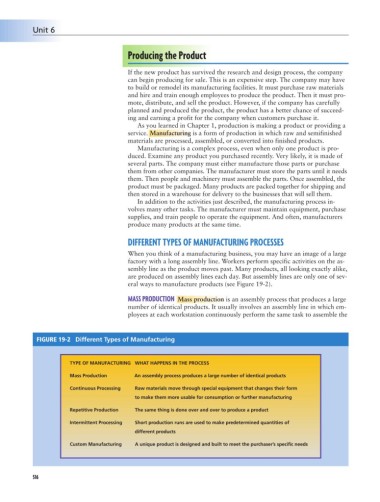
                                                eral ways to manufacture products (see Figure 19-2).

                                                MASS PRODUCTION Mass production is an assembly process that produces a large
                                                number of identical products. It usually involves an assembly line in which em-
                                                ployees at each workstation continuously perform the same task to assemble the


                   FIGURE 19-2 Different Types of Manufacturing


                             TYPE OF MANUFACTURING   WHAT HAPPENS IN THE PROCESS

                             Mass Production                     An assembly process produces a large number of identical products
                             Continuous Processing     Raw materials move through special equipment that changes their form
                                                  to make them more usable for consumption or further manufacturing
                             Repetitive Production    The same thing is done over and over to produce a product

                             Intermittent Processing      Short production runs are used to make predetermined quantities of
                                                  different products

                             Custom Manufacturing     A unique product is designed and built to meet the purchaser’s specific needs


                  516

