


Page 530 - Business Principles and Management
P. 530
Chapter 19 • Product Planning and Production Management


                        product. Many products you use are assembled
                        through mass production. Automobiles, cameras,
                        home appliances, and many brands of computers
                        are mass-produced.
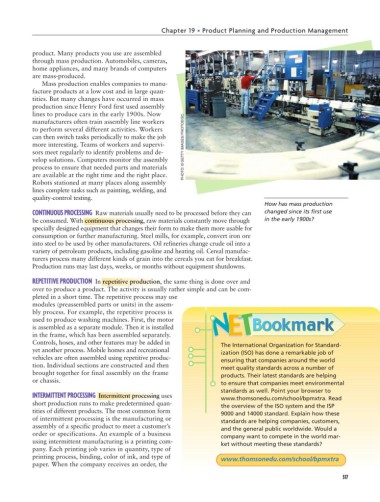
                           Mass production enables companies to manu-
                        facture products at a low cost and in large quan-
                        tities. But many changes have occurred in mass
                        production since Henry Ford first used assembly
                        lines to produce cars in the early 1900s. Now
                        manufacturers often train assembly line workers
                        to perform several different activities. Workers
                        can then switch tasks periodically to make the job
                        more interesting. Teams of workers and supervi-  PHOTO: © GETTY IMAGES/PHOTODISC.
                        sors meet regularly to identify problems and de-
                        velop solutions. Computers monitor the assembly
                        process to ensure that needed parts and materials
                        are available at the right time and the right place.
                        Robots stationed at many places along assembly
                        lines complete tasks such as painting, welding, and
                        quality-control testing.
                                                                                                 How has mass production
                        CONTINUOUS PROCESSING Raw materials usually need to be processed before they can  changed since its first use
                        be consumed. With continuous processing, raw materials constantly move through  in the early 1900s?
                        specially designed equipment that changes their form to make them more usable for
                        consumption or further manufacturing. Steel mills, for example, convert iron ore
                        into steel to be used by other manufacturers. Oil refineries change crude oil into a
                        variety of petroleum products, including gasoline and heating oil. Cereal manufac-
                        turers process many different kinds of grain into the cereals you eat for breakfast.
                        Production runs may last days, weeks, or months without equipment shutdowns.

                        REPETITIVE PRODUCTION In repetitive production, the same thing is done over and
                        over to produce a product. The activity is usually rather simple and can be com-
                        pleted in a short time. The repetitive process may use
                        modules (preassembled parts or units) in the assem-
                        bly process. For example, the repetitive process is
                        used to produce washing machines. First, the motor
                        is assembled as a separate module. Then it is installed
                        in the frame, which has been assembled separately.
                        Controls, hoses, and other features may be added in        The International Organization for Standard-
                        yet another process. Mobile homes and recreational         ization (ISO) has done a remarkable job of
                        vehicles are often assembled using repetitive produc-      ensuring that companies around the world
                        tion. Individual sections are constructed and then         meet quality standards across a number of
                        brought together for final assembly on the frame           products. Their latest standards are helping
                        or chassis.
                                                                                   to ensure that companies meet environmental
                                                                                   standards as well. Point your browser to
                        INTERMITTENT PROCESSING Intermittent processing uses       www.thomsonedu.com/school/bpmxtra. Read
                        short production runs to make predetermined quan-          the overview of the ISO system and the ISP
                        tities of different products. The most common form         9000 and 14000 standard. Explain how these
                        of intermittent processing is the manufacturing or         standards are helping companies, customers,
                        assembly of a specific product to meet a customer’s        and the general public worldwide. Would a
                        order or specifications. An example of a business          company want to compete in the world mar-
                        using intermittent manufacturing is a printing com-        ket without meeting these standards?
                        pany. Each printing job varies in quantity, type of
                        printing process, binding, color of ink, and type of       www.thomsonedu.com/school/bpmxtra
                        paper. When the company receives an order, the

                                                                                                                          517

