


Page 563 - Business Principles and Management
P. 563
Unit 6


                                                                Depending on who is making the purchase and how they will
                                                             use it, a product may be both a consumer good and an industrial
                                                             good. Gasoline and laptop computers, for instance, may be pur-
                                                             chased by consumers in small quantities or by businesses in large
                                                             quantities.


                                                             TYPES OF CONSUMER PRODUCTS
                                                             To look at the attributes of consumer goods more specifically, mar-
                                                             keters group them into four categories: convenience goods, shop-
                                                             ping goods, specialty goods, and unsought goods. The categories
                                                             are based on (1) how important the product is to the customer
                                                             and (2) whether the customer is willing to spend time to compare
                                                             products and brands before making a decision to buy. Companies
                                                        PHOTO: © DIGITAL VISION.  that consumers purchase regularly without a great deal of thought.
                                                             make different marketing decisions, depending on which category
                                                             of consumer goods they are selling.

                                                             CONVENIENCE GOODS Convenience goods are inexpensive items

                                                             Consumers are not willing to shop around for these products
                                                             because they purchase them often, the many competing prod-
                                                ucts do not differ much from each other, and they don’t cost much money.
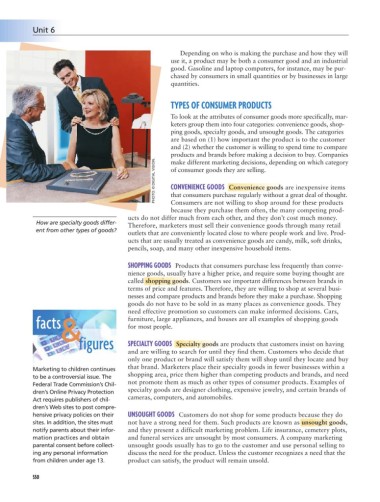
                   How are specialty goods differ-  Therefore, marketers must sell their convenience goods through many retail
                   ent from other types of goods?
                                                outlets that are conveniently located close to where people work and live. Prod-
                                                ucts that are usually treated as convenience goods are candy, milk, soft drinks,
                                                pencils, soap, and many other inexpensive household items.


                                                SHOPPING GOODS Products that consumers purchase less frequently than conve-
                                                nience goods, usually have a higher price, and require some buying thought are
                                                called shopping goods. Customers see important differences between brands in
                                                terms of price and features. Therefore, they are willing to shop at several busi-
                                                nesses and compare products and brands before they make a purchase. Shopping
                                                goods do not have to be sold in as many places as convenience goods. They
                                                need effective promotion so customers can make informed decisions. Cars,
                   facts   &                    furniture, large appliances, and houses are all examples of shopping goods
                                                for most people.
                                figures         SPECIALTY GOODS Specialty goods are products that customers insist on having

                                                and are willing to search for until they find them. Customers who decide that
                                                only one product or brand will satisfy them will shop until they locate and buy
                  Marketing to children continues  that brand. Marketers place their specialty goods in fewer businesses within a
                  to be a controversial issue. The  shopping area, price them higher than competing products and brands, and need
                  Federal Trade Commission’s Chil-  not promote them as much as other types of consumer products. Examples of
                  dren’s Online Privacy Protection  specialty goods are designer clothing, expensive jewelry, and certain brands of
                  Act requires publishers of chil-  cameras, computers, and automobiles.
                  dren’s Web sites to post compre-
                  hensive privacy policies on their  UNSOUGHT GOODS Customers do not shop for some products because they do
                  sites. In addition, the sites must  not have a strong need for them. Such products are known as unsought goods,
                  notify parents about their infor-  and they present a difficult marketing problem. Life insurance, cemetery plots,
                  mation practices and obtain   and funeral services are unsought by most consumers. A company marketing
                  parental consent before collect-  unsought goods usually has to go to the customer and use personal selling to
                  ing any personal information  discuss the need for the product. Unless the customer recognizes a need that the
                  from children under age 13.   product can satisfy, the product will remain unsold.


                  550

