


Page 599 - Business Principles and Management
P. 599
Unit 6


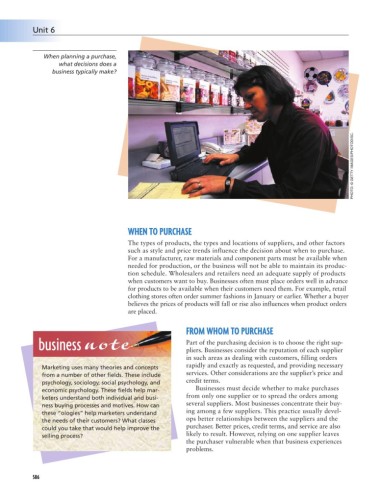
                     When planning a purchase,
                          what decisions does a
                        business typically make?


                                                                                                                       PHOTO: © GETTY IMAGES/PHOTODISC.


                                                WHEN TO PURCHASE
                                                The types of products, the types and locations of suppliers, and other factors
                                                such as style and price trends influence the decision about when to purchase.
                                                For a manufacturer, raw materials and component parts must be available when
                                                needed for production, or the business will not be able to maintain its produc-
                                                tion schedule. Wholesalers and retailers need an adequate supply of products
                                                when customers want to buy. Businesses often must place orders well in advance
                                                for products to be available when their customers need them. For example, retail
                                                clothing stores often order summer fashions in January or earlier. Whether a buyer
                                                believes the prices of products will fall or rise also influences when product orders
                                                are placed.

                    business note                                 FROM WHOM TO PURCHASE

                                                                  Part of the purchasing decision is to choose the right sup-
                                                                  pliers. Businesses consider the reputation of each supplier
                                                                  in such areas as dealing with customers, filling orders
                     Marketing uses many theories and concepts    rapidly and exactly as requested, and providing necessary
                     from a number of other fields. These include  services. Other considerations are the supplier’s price and
                     psychology, sociology, social psychology, and  credit terms.
                     economic psychology. These fields help mar-     Businesses must decide whether to make purchases
                     keters understand both individual and busi-  from only one supplier or to spread the orders among
                     ness buying processes and motives. How can   several suppliers. Most businesses concentrate their buy-
                     these “ologies” help marketers understand    ing among a few suppliers. This practice usually devel-
                     the needs of their customers? What classes   ops better relationships between the suppliers and the
                     could you take that would help improve the   purchaser. Better prices, credit terms, and service are also
                     selling process?                             likely to result. However, relying on one supplier leaves
                                                                  the purchaser vulnerable when that business experiences
                                                                  problems.


                  586

